Sho T KNOWLEDGE

An AI connection and access right to a book's knowledge

Physical AI Knowledge
Access Pass

What is “knowledge access”?A service that connects the knowledge in the book “Physical AI — AI Begins to Move the World” to your own AI so you can explore it. Starting from any theme that interests you, you can deepen your thinking across concepts, examples and chapters.

What you buy
You are buying an access right (MCP access) for your AI to connect to the book's knowledge.
Not included
This is not a sale of the book's text, a PDF or a physical card.

The purchase screens, your account page, the Tips page and the legal pages are currently in Japanese only. Your AI can talk with you in your own language.
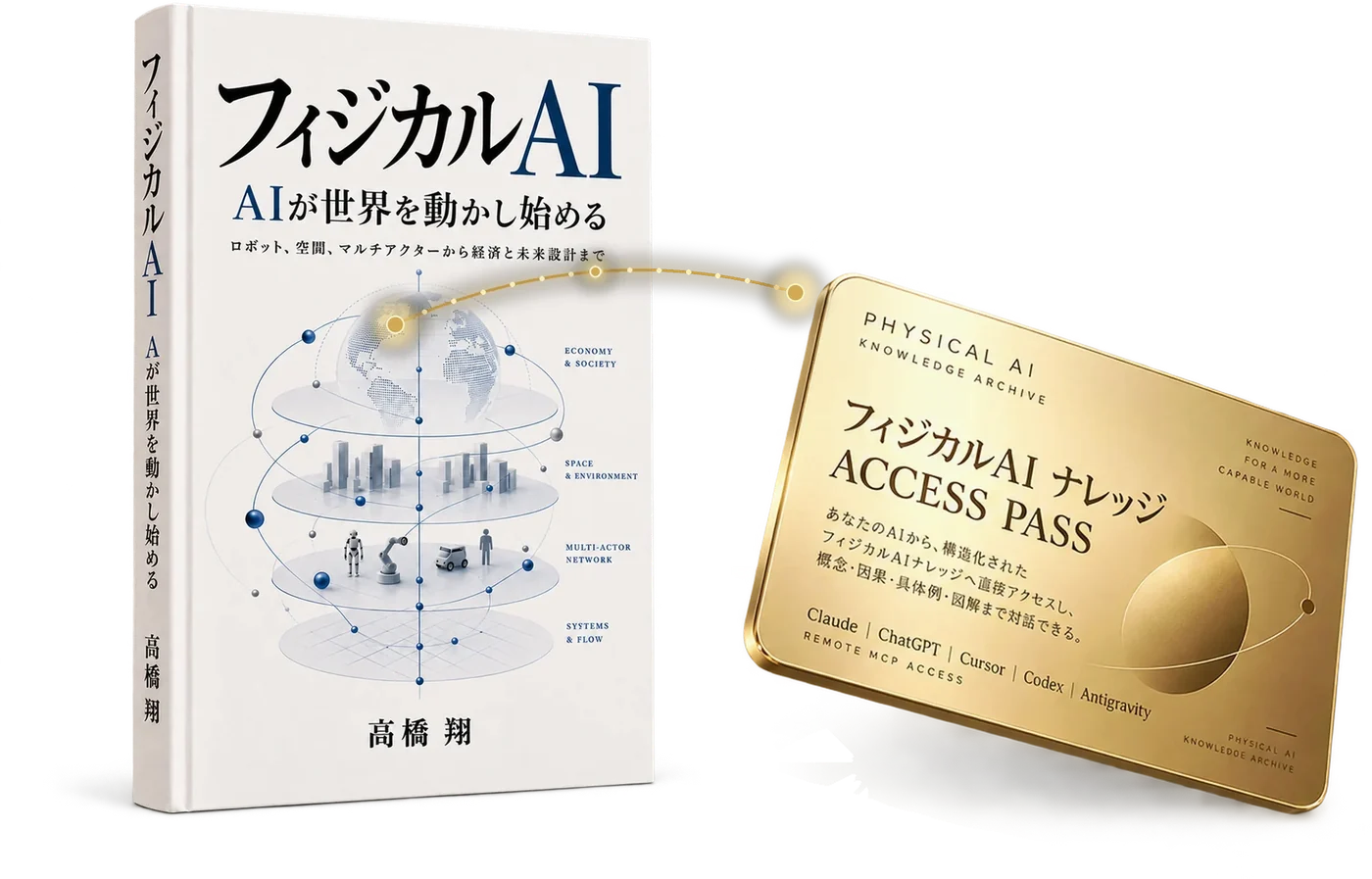
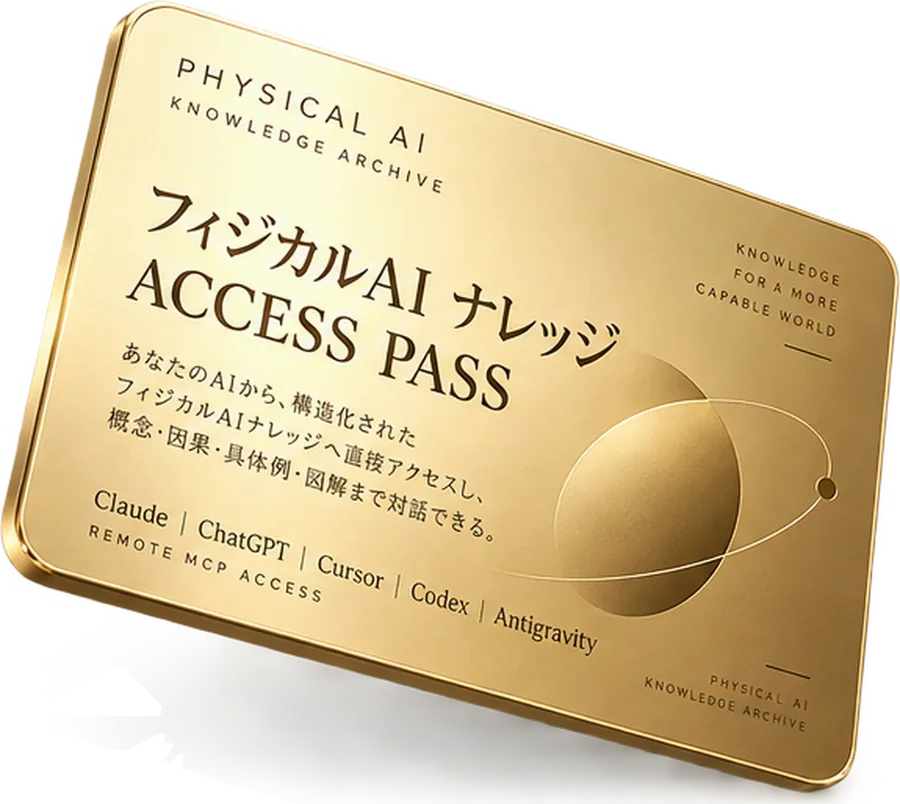
The book “Physical AI — AI Begins to Move the World” and an Access Pass card joined by a gold line. No physical card is shipped.

The book's knowledge → to your AI

*This is not a sale of a physical card. It is a sale of an access right (MCP access) for your AI to connect to the book's knowledge.
1,000 JPYCor10 USDC

Either option: tax included, fixed amount, one-time purchase

See how to buy (opens in a new tab) ↗
Preparation, guarantee and personal data before you buy
Service guaranteed for at least 3 months from purchase

It does not stop working automatically after 3 months. You can keep using it as long as the service continues, but provision is not guaranteed forever.

No name, email address or password needed

We never hold your wallet's private key or recovery phrase. We do handle your wallet address and the order, payment and authentication records needed to manage purchases and use.

What you need before buying
① A supported wallet app (phone / PC)② JPYC or USDC + the network fee for the transfer③ An AI that can set up MCP connections (when using)

Supported wallet apps and transfer networks are shown on the purchase screen. Check requirements and preparation ↗

Guarantee
Service guaranteed for at least 3 months from the date of purchase
Networks
Ethereum, Polygon, Avalanche
Choose the network and currency when you buy.
Fees
The network fee for the transfer (gas) is required separately.
USDC
The yen value of 10 USDC is not guaranteed to equal 1,000 yen.

TWO WAYS TO EXPLORE

Reading a book and talking with its knowledge through AI are different experiences.

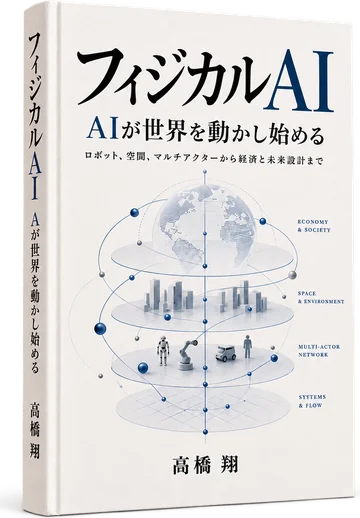
Cover of the book “Physical AI — AI Begins to Move the World”BookTake in the author's words closely.Read the text and build understanding along its structure.The book is on sale at Amazon (Kindle, Japanese) ↗About the book →
+
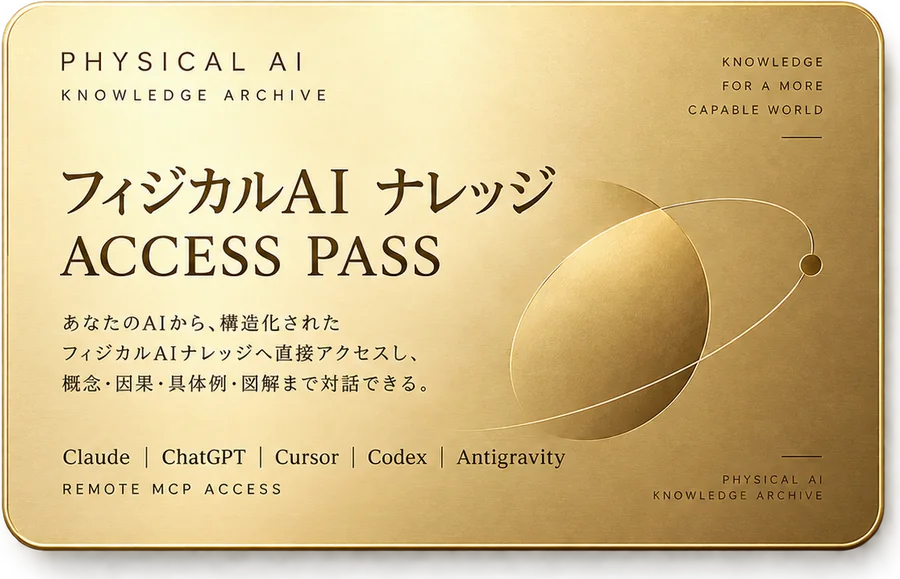
Image of the Access Pass cardAccess Pass (the product on this page)Explore the knowledge from your own questions.Ask across chapters and deepen your own questions.Buy the Access Pass (Japanese) →*This is not a sale of a physical card. It is a sale of an access right (MCP access) for your AI to connect to the book's knowledge.

About this book

What does “Physical AI — AI Begins to Move the World” describe?

What changes when AI no longer just provides information but perceives, judges and acts in physical space? Rather than discussing only robot performance, the book connects the role of humans, business and the economy, society, and the design of the future.

What makes this book distinctive is that it doesn't stop at explaining technology. Connect it to your AI with the Access Pass, and you can ask from your own interests and trace links to other chapters, concepts and examples in the book.

GET STARTED

From purchase to talking with it through your AI.

What happens after you buy is simple.

*This is not a sale of a physical card. It is a sale of an access right (MCP access) for your AI to connect to the book's knowledge.
01Buy with your wallet

After a free identity-check signature, pay with JPYC or USDC.

02Go to your page

Once payment is confirmed, check your access right and connection code.

03Connect your AI

Register the connection in ChatGPT, Claude or another AI and authorize it.

04Explore the book

Dig into the concepts, examples and links between chapters that interest you, together with your AI.

EXPLORE THE BOOK

What kind of dialogue can you have with this book's knowledge?

When you ask your AI, you can deepen your thinking while tracing related points, using the book's ideas and examples as clues.

For example, starting from questions like these

The buttons above switch between sample explanations. In practice, you ask whatever you like, and your AI thinks it through with you by tracing the book's knowledge.

✳
Exploring with AIIllustrative conversation, not a live response
How do “capability,” “authority” and “delegation” in Chapter 6 differ?

Capability asks “what can it do,” authority asks “what may it do,” and delegation asks “on whose behalf does it act” — three separate questions. The book goes further, covering agent identification and auditing as conditions for an acting agent to behave safely.

Related: Chapter 6, sections 6-1, 6-4, 6-7, 6-9
Check the chapters and sections behind it, then ask your next question.

BOOK CONTENTS × QUESTIONS

Trace the whole book from the questions you care about.

This book connects robots, space, people and society, the economy and the design of the future. We have added sample questions for your AI to the actual table of contents. Look over every chapter title and tap the ones that interest you.

Contents and sample questions Prologue + 17 chapters + final chapter

All chapter titles are shown. Use “See sections & a question” to check what's inside. (Chapter titles are translated from the Japanese book.)

Prologue, all 17 chapters and the final chapter. Open “See sections & a question” on any chapter to see key sections and a question you can ask your AI.

IntroductionPrologue
Why it matters that AI acts on the physical world
PrologueAI Begins to Move the World — The Assumptions Physical AI RewritesSee sections & a question +

Key sections in this chapter

  • 0-2 Judge AI's evolution not only by “intelligence” but by its “range of action”
  • 0-7 The more AI “can do,” the more “what we want to realize” matters
Sample question for your AI: “First, tell me the view of “Physical AI” at the center of this book.”
Technology and spaceCh. 1–3
Seeing robots, simulation and space as one system
Ch. 1Physical AI Is More Than “the Evolution of Robots”See sections & a question +

Key sections in this chapter

  • 1-3 “Perception → judgment → action → result” becomes a closed loop
  • 1-6 The unit of automation rises from “tasks” to an “actor graph” (actor composition)
Sample question for your AI: “Why is Physical AI not just about a single smart robot?”
Ch. 2The Simulation Internet — Generating Not Just Data but “Experience”See sections & a question +

Key sections in this chapter

  • 2-2 From synthetic data to synthetic experience
  • 2-6 From single-robot learning to multi-actor simulation
Sample question for your AI: “What is the difference between “synthetic data” and “synthetic experience”?”
Ch. 3The Overall Architecture of the Physical AI EraSee sections & a question +

Key sections in this chapter

  • 3-4 Don't make only robots smarter — make spaces Physical-AI-native too
  • 3-9 Connecting the whole stack on a single page
Sample question for your AI: “Why do we need to design both robots and spaces?”
People and societyCh. 4–6
How people work, designing goals, authority and delegation
Ch. 4Human “Verbs” ChangeSee sections & a question +

Key sections in this chapter

  • 4-3 From being present → to placing agency (an acting agent)
  • 4-8 Four scenes show how deep the change goes
Sample question for your AI: “How does work change when “operating” becomes “delegating”?”
Ch. 5Moving the World by “States,” Not “Procedures”See sections & a question +

Key sections in this chapter

  • 5-2 From procedures to goal states
  • 5-9 From robot programming to world programming
Sample question for your AI: “What is the difference between “instructing procedures” and “specifying goal states”?”
Ch. 6How Should Society Treat Non-Human Agency?See sections & a question +

Key sections in this chapter

  • 6-1 Separate capability (the ability to act) from authority
  • 6-4 Delegation — on whose behalf is it acting?
  • 6-7 Audit (auditing and tracing) — recording not only actions but intent and delegation
Sample question for your AI: “Explain, with concrete examples, how “capability, authority, delegation and audit” in Chapter 6 relate.”
Economy, business, implementationCh. 7–10
Conditions for implementation, supply capacity, changes in companies and markets
Ch. 7Beyond Efficiency, Toward a “Supply Capacity Expansion Market”See sections & a question +

Key sections in this chapter

  • 7-4 “Not profitable with people” becomes a market
  • 7-9 Physical AI can be not only “AI that compresses the economy” but “AI that expands it”
Sample question for your AI: “Besides cutting labor costs, what markets does Physical AI create?”
Ch. 8Where Does Physical AI Become Real? — A Deployment Map for the World and JapanSee sections & a question +

Key sections in this chapter

  • 8-4 Read the deployment map by task, not by industry name
  • 8-10 Not “when will it come” but “what must change for it to come”
Sample question for your AI: “Rather than which year Physical AI spreads, under what conditions can it be implemented?”
Ch. 9Some IT / SaaS Companies Will Extend into the Control Plane of the Physical WorldSee sections & a question +

Key sections in this chapter

  • 9-4 You can own on-site operations without building robots
  • 9-10 But becoming a control plane comes with new responsibilities
Sample question for your AI: “What does it mean for a SaaS company to become the control plane of a site without building robots?”
Ch. 10Not Just Labor Saving, but Building “a Different Graph”See sections & a question +

Key sections in this chapter

  • 10-4 Logistics — from “robotizing people's jobs” to “running the whole site by mission”
  • 10-6 Retail — from “staff completing tasks” to “a group of actors maintaining the store's state”
Sample question for your AI: “Using logistics and retail, explain the difference between “efficiency” and “a different graph.””
Designing the futureCh. 11–15
Reading the direction and making the future you want real
Ch. 11Reading “the Vector of the Times” from Future ResidentsSee sections & a question +

Key sections in this chapter

  • 11-3 Signals (signs) and vectors (directions) are different
Sample question for your AI: “What is the difference between a “signal” and a “vector” of the future?”
Ch. 12Goal / Vector Architect — The Most Upstream Role in the AI EraSee sections & a question +

Key sections in this chapter

  • 12-5 Don't confuse vectors and goals
  • 12-6 Backcasting “works backward from the future to the conditions”
Sample question for your AI: “How do “vector,” “goal” and “backcasting” connect?”
Ch. 13Not “Solving” Structural Problems, but Restructuring the Structure ItselfSee sections & a question +

Key sections in this chapter

  • 13-7 From “problem solving” to “problem dissolving”
Sample question for your AI: “What is the difference between solving a problem and changing the structure that creates it?”
Ch. 14From Backcast to Fact — An Ecosystem That Turns the Future into FactSee sections & a question +

Key sections in this chapter

  • 14-4 A fact is not “a successful PoC”
Sample question for your AI: “How does the book's idea of “turning the future into fact” differ from a PoC succeeding?”
Ch. 15Places, Culture, and Economic Spheres — How to Break Through Japan's Structural ProblemsSee sections & a question +

Key sections in this chapter

  • 15-1 Don't see Japan's problems only in terms of “what is missing”
Sample question for your AI: “How should we rethink Japan's structural problems, including culture and economic spheres?”
The human originCh. 16–17
What humans want in an era when machines act
Ch. 16When the Machine Economy Grows, What Do Humans Remain the Origin Of?See sections & a question +

Key sections in this chapter

  • 16-1 “Will it take our jobs?” alone is a question one level too low
  • 16-5 Machine demand has at least three layers
Sample question for your AI: “As the machine economy expands, what will humans remain the ones to decide?”
Ch. 17The Futurist Producer in the Age of Physical AISee sections & a question +

Key sections in this chapter

  • 17-1 A Futurist is not “someone who predicts the future”
Sample question for your AI: “What role does the “Futurist Producer” described in the book play?”
ClosingFinal Chapter
From prediction to design and execution
Final ChapterThe Future Shifts from “Something to Predict” to “Something to Design”See sections & a question +

Key sections in this chapter

    Sample question for your AI: “Across the whole book, what questions should humans take on in the AI era?”

    The contents are taken from the book's knowledge. Questions and answers are illustrative examples; your AI's responses will vary with your environment.

    USE YOUR OWN AI

    From your everyday AI to the book's knowledge.

    We explain how to connect for each AI. Using it requires setting up an MCP (external) connection on the AI side.

    *This is not a sale of a physical card. It is a sale of an access right (MCP access) for your AI to connect to the book's knowledge.
    ChatGPTSee how to connect and requirementsSee the steps →
    ClaudeSee how to connect and requirementsSee the steps →
    CursorSee how to connect and requirementsSee the steps →
    CodexSee how to connect and requirementsSee the steps →
    AntigravitySee how to connect and requirementsSee the steps →
    Gemini CLISee how to connect and requirementsSee the steps →
    How to connect each AI ↗Tips that help after you connect (Japanese) ↗

    KNOWLEDGE ACCESS PASS

    Explore the knowledge in “Physical AI — AI Begins to Move the World” with your everyday AI.

    A digital access right for using an MCP connection to the book's knowledge.

    1,000 JPYCor10 USDC

    Tax included, one-time purchase Go to purchase (Japanese) → See how to buy ↗ Already purchased (Japanese) →