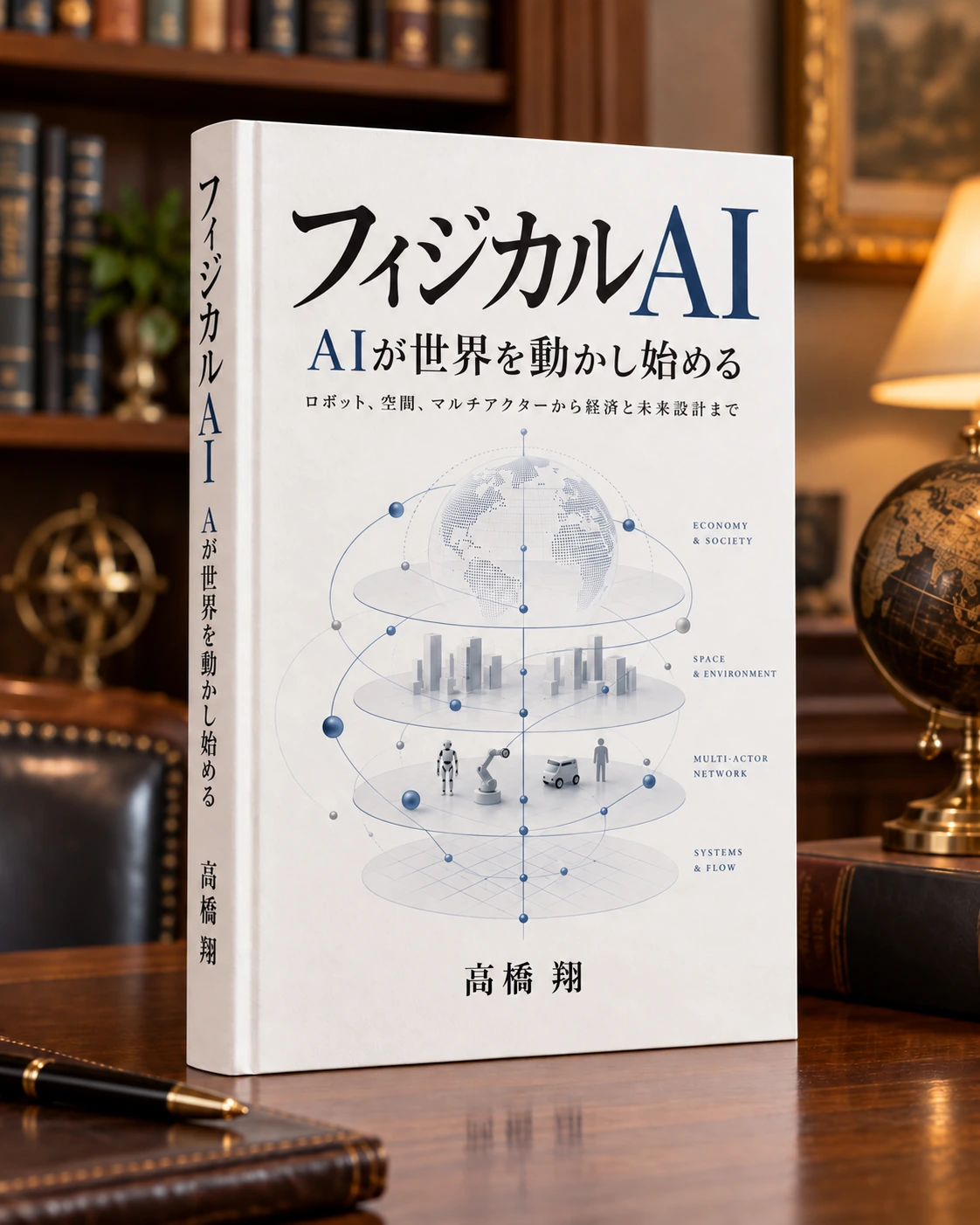
Please check the Amazon product page for Kindle Unlimited availability and pricing.
* This book is written in Japanese (sold on Amazon.co.jp).
About this Book
A book that draws, in one continuous line, the world after AI steps “off the screen.”
Generative AI has greatly expanded our ability to create “information” — text, images, and code. What is now beginning is a shift in which AI, through robots, equipment, and spaces, starts to move the physical world itself.
This book does not stop at robots or technology. When technology changes, the structures of society, the economy and business, and even the question of “what future do we want to build?” change in a chain reaction. The book follows that flow step by step across 5 parts and 17 chapters.
PART I
AI Steps Off the Screen — The Architecture of Physical AI
Chapter 1: Physical AI Is More Than “the Evolution of Robots”
Chapter 2: The Simulation Internet — Generating Not Just Data but “Experience”
Chapter 3: The Overall Architecture of the Physical AI Era
PART II
Rebuilding a Social OS That Assumed Only Humans
Chapter 4: Human “Verbs” Change
Chapter 5: Moving the World by “States,” Not “Procedures”
Chapter 6: How Should Society Treat Non-Human Agency?
PART III
Where Physical AI Becomes Real, and How It Rewrites the Economy and Business
Chapter 7: Beyond Efficiency, Toward a “Supply Capacity Expansion Market”
Chapter 8: Where Does Physical AI Become Real? — A Deployment Map for the World and Japan
Chapter 9: Some IT / SaaS Companies Will Extend into the Control Plane of the Physical World
Chapter 10: Not Just Labor Saving, but Building “a Different Graph”
PART IV
Futurist Producer — Reading the Future and Building the Structures That Make It Real
Chapter 11: Reading “the Vector of the Times” from Future Residents
Chapter 12: Goal / Vector Architect — The Most Upstream Role in the AI Era
Chapter 13: Not “Solving” Structural Problems, but Restructuring the Structure Itself
Chapter 14: From Backcast to Fact — An Ecosystem That Turns the Future into Fact
Chapter 15: Places, Culture, and Economic Spheres — How to Break Through Japan's Structural Problems
PART V
The More AI Takes On the How, the More Humans Are Asked “What Do We Want?”
Chapter 16: When the Machine Economy Grows, What Do Humans Remain the Origin Of?
Chapter 17: The Futurist Producer in the Age of Physical AI
Final Chapter: The Future Shifts from “Something to Predict” to “Something to Design”
Author
Sho Takahashi (Sho T) / Futurist
Structure
5 parts, 17 chapters
Format
Amazon Kindle
Introduction / Reframe
Physical AI is more than “robots getting smarter.”
What generative AI dramatically changed was the Cost of creating information. What Physical AI expands is the range over which that intelligence closes the loop all the way to Action in the physical world.
DIGITAL AIAI → Information
Text, images, code, decisions. The main Output comes back as information.
Expands
PHYSICAL AIAI → Action → World State Change
Intelligence changes the state of reality itself through Humans / Robots / Equipment / Spaces.
Look at AI's progress not only by “how smart it is,” but by “how far it can act on the world.”
Fig. 1AI's Output expands from Information to Physical ActionFive Reframes
This book rewrites five assumptions.
If you see Physical AI only as a race for robot performance, you will miss the changes it brings to society, business, the economy, and future design.
Reframe 01Robot → Actor Graph
The unit of automation shifts from a single robot to an Actor Graph
See Humans, AI, Robots, Equipment, and Spaces not as standalone units, but as a structure of interactions that together achieve a Goal. Simply replacing people with robots does not complete the design of Physical AI.
Fig. 2See it not as a standalone robot, but as an Actor Graph that achieves a Goal
Reframe 02Procedure → Desired State
Instead of fixing procedures, define the state you want to achieve
The more AI and robots can choose the How on their own, the more what humans hand over moves up from detailed Procedures to Desired States, Constraints, Authority, and Success Criteria.
Fig. 3From Procedure to Desired State: moving the world from a higher layer
Reframe 03Human Verbs Change
In the age of Physical AI, human “verbs” change
Operate → delegate. Be present → place Agency. Synchronize → collaborate asynchronously through a Shared State. Monitor → look at Exceptions. The very grammar of the relationship between humans and the world changes.
Fig. 4Human verbs: Before → After
Reframe 04Automation → Supply Capacity
Beyond labor saving lies the expansion of supply capacity itself
The economic value of Physical AI is not only about making the same Output cheaper. As Action Costs fall and operating hours, Actors, places, times, and Tasks expand, things that could never be supplied before may become possible to supply.
Fig. 5Not just Labor Saving — Supply Capacity Expansion
Reframe 05Prediction → Future Architecture
From “What will happen?” to “What should we make happen?”
The more AI takes on the How, the scarcer the Goal becomes — what we actually want to bring about. Read the Vector, set the Goal, Backcast, find the Structural Bottleneck, and connect Experiments to Facts. The future is treated as something to be designed.
Fig. 6From the technology of Physical AI to Future → Fact
Scope
In short, this is not just a book explaining robots.
It is not only about technology. Not only about the economy. Not only about the future. It describes the structure through which all of these connect into one line as AI begins to act on the Physical World.
Technology
Technology: how AI works in the real world
It describes not the performance of a single robot, but the overall structure in which AI, robots, equipment, and spaces connect to make work happen.
The overall structure of Physical AI
Generating “experience” through simulation
Collaboration among people, AI, and robots (multi-actor)
Infrastructure on the space side that robots can easily use
Mechanisms for delegating authority to AI
Economy / Business
Economy and business: how industries change
It examines changes that go beyond cutting labor costs — where things that could never be supplied before become possible to supply.
“Supply capacity expansion” beyond labor saving
Where practical deployment advances first, worldwide and in Japan
IT / SaaS companies becoming the foundation that moves the physical world
New ways of organizing work that emerge when human constraints are removed
Future Design
Future design: how to build the future
Rather than guessing “what will happen,” it is a way of thinking that decides “what to make happen” and turns it into real-world fact.
Reading the flow of the times (the vector)
Designing the target state concretely
Working backward from the future (backcasting)
Identifying the structures that are truly stuck
Creating facts you can decide on through small experiments
The full picture, where technology, the economy, and future design connect into one line, is in the book.
The book turns its concepts not only into text but into many diagrams — Architectures, Graphs, Loops, and Before / Afters. Here we share just a few of them. Click or tap a figure to enlarge it.
Simulation Internet
Generate not just Data, but Synthetic Experience that involves Action.
Design not only Can Act? but May Act?, along with Delegation, Authority, and Accountability.
Real-World Action
The possibility that software's Boundary extends from Record to Physical Action.
Different Graph
Not just replacing people: as Human Constraints are removed, the Topology itself changes.
Goal Architecture
Design not only the KPIs, but the structure that makes that world possible.
Narrative → Fact
Fill the Actor / Capital / Institution / Place / Risk gaps between the Future Narrative and Fact.
Future-to-Fact Loop
Make one Loop from Vector to Goal, Experiment, Decision-grade Fact, and Update.
Questions
Which question would you start reading from?
Each chapter of the book hands off not to an explanation of concepts, but to the question “So what about my own company, industry, or workplace?” If even one of these catches your attention, start reading from that chapter.
2 a.m., an unmanned logistics hub.
Packages move, decisions are made, and only exceptions are escalated to people. What changed was not the content of the work, but the “verbs” people use toward the world.
When humans no longer operate things, what are they doing?
Covered in PART II (Chapter 4)
“Go to shelf 7 and carry box 32” versus “Have everything ready to ship by 6 a.m.”
They look like the same instruction, but they move entirely different layers of the world. From an era of handing over procedures to an era of handing over the states we want to achieve.
When what humans hand over becomes a “state,” what decisions remain as human work?
Covered in PART II (Chapter 5)
Late at night, in hazardous zones, in places people cannot go.
There is work that has long been left behind there. This is not a story about lower labor costs. It is a story about things that could never be supplied becoming possible to supply.
How much “demand we gave up on because it was too expensive” lies dormant?
Covered in PART III (Chapter 7)
“Will humanoids become widespread in 2030, or 2035?”
Right next to that debate, it already works for certain limited tasks in some factories. The future does not arrive all at once. It arrives at different speeds, task by task and place by place.
When, and from where, will it reach your industry?
Covered in PART III (Chapter 8)
The vision was good. The proof of concept succeeded. And yet the world did not change.
What was missing was not technology, but structure: who takes responsibility, who provides the capital, and where it gets tested.
To turn the future into fact, where is the gap we truly need to fill?
Covered in PART IV (Chapters 13–14)
The bigger the machine-driven economy grows, the smaller the place for humans — or is that really so?
As long as we decide what we want, humans remain the origin of demand and purpose.
In a world where more futures can be executed, which future will we choose?
Covered in PART V (Chapter 16)
For Readers
Who it's for.
Technology / AI
For those who want to understand Physical AI not as humanoids alone, but as an Architecture that includes Simulation, Space, and Multi-Actor systems.
Business / Strategy
For those who want to think about how Physical AI will change IT / SaaS, companies, industries, supply capacity, and economic structures.
Futurist / Producer
For those who want to go beyond technology forecasting and design all the way from the future they want → Goal → Backcast → Fact.
If this caught your interest, continue reading on Amazon Kindle.
A Futurist who produces the conditions under which a future can come true — envisioning the future beyond irreversible change, backcasting from it to the present, and working across technology, business, institutions, capital, culture, and space.
He spent 11 years in new business and business development at NTT East. Since then, he has continued to connect ideas to business and society across very different positions — companies, industry associations, universities, and technology communities.
He is currently Representative Director of the AI&NoCoders Japan Association, CINO (Chief Innovation Officer) of Pressman Co., Ltd., Visiting Professor at iU (Professional University of Information and Management for Innovation), and Co-Founder of ICP Japan.
Building on that experience, this book looks at the Physical AI era, in which humans, AI, robots, equipment, spaces, and institutions interact, and offers the perspective of moving from predicting the future to designing it and turning it into fact.
What kind of book is Physical AI: AI Begins to Move the World?
It is a book that traces, in one continuous line, how AI is stepping off the screen and beginning to move the physical world — across technology, society, the economy and business, and future design. Rather than explaining standalone robots, it covers the big picture of how people, AI, robots, equipment, and spaces work together to make work and society function. It consists of 5 parts and 17 chapters. (The book is written in Japanese.)
Who is it for?
It is written for people in technology and AI who want to understand Physical AI as an overall structure rather than as humanoids alone; people in business and strategy who want to think about its impact on industries, companies, IT / SaaS, and the economy; and people who want to go beyond technology forecasting to design the future they want to achieve and turn it into fact.
Where can I read it?
It is available on Amazon Kindle (Japanese edition, Amazon.co.jp). Please check the Amazon product page for Kindle Unlimited availability and pricing.
Who is the author?
Sho Takahashi (Sho T). After 11 years in new business and business development at NTT East, he now works as a Futurist: Representative Director of the AI&NoCoders Japan Association, CINO of Pressman Co., Ltd., Visiting Professor at iU (Professional University of Information and Management for Innovation), and Co-Founder of ICP Japan.
Read on Kindle
When AI begins to move the world, what will we design?
Physical AI: AI Begins to Move the World is available on Amazon Kindle (in Japanese). Please check the Amazon product page for Kindle Unlimited availability and purchase price.