IN SHORT
What is the Network States — Knowledge Access Pass?
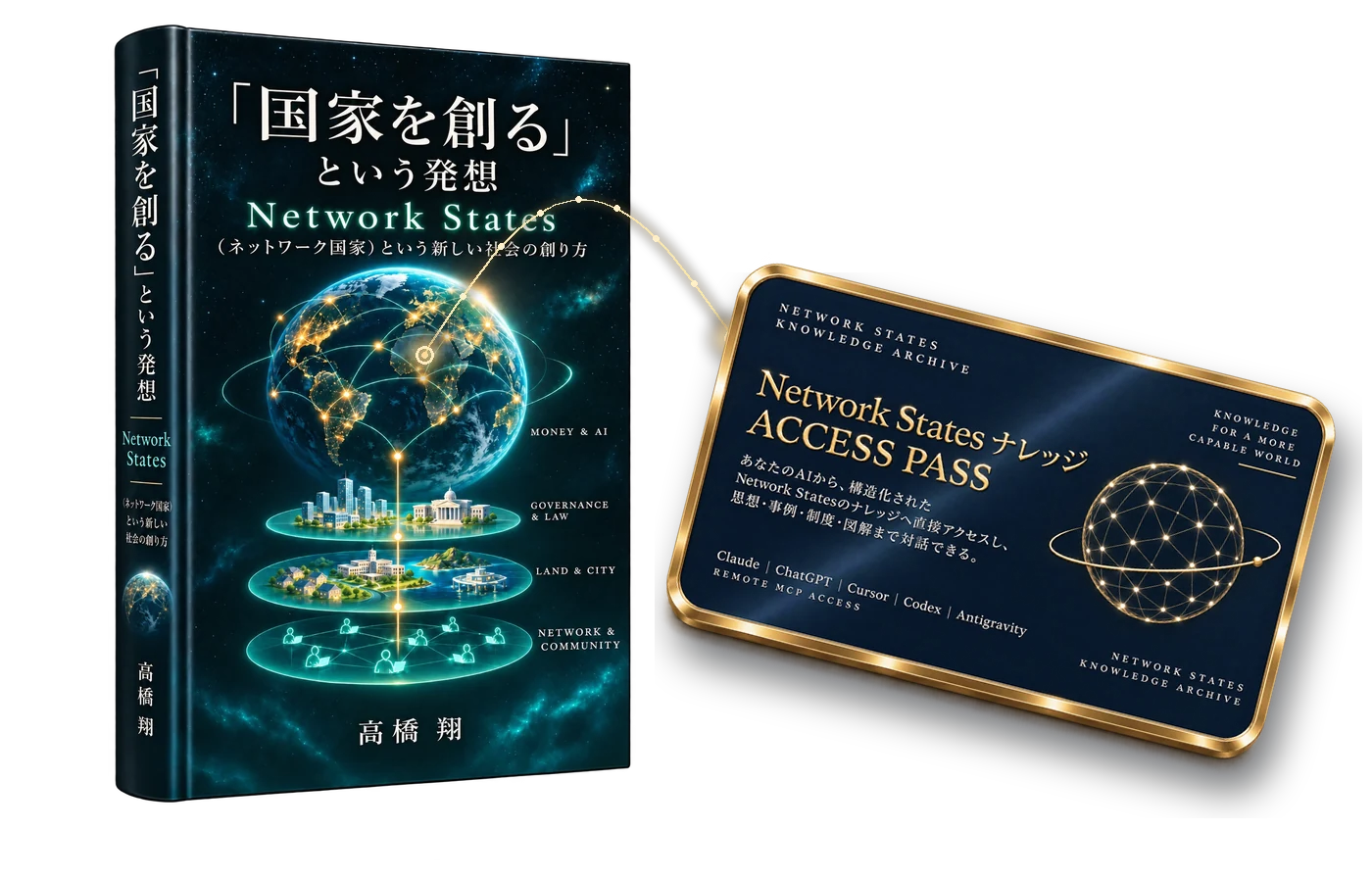
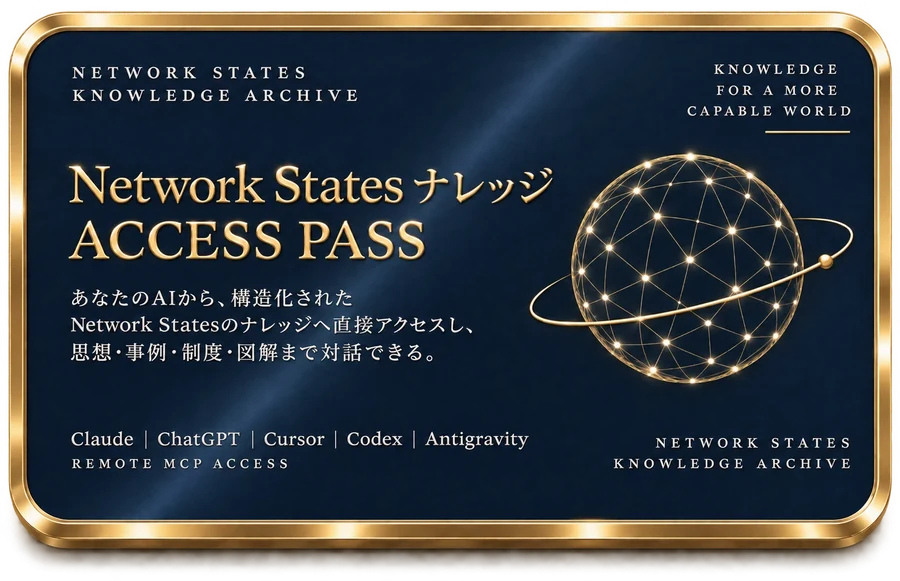
An access right that connects the knowledge in “The Idea of Creating a State — ‘Network States’ and the Making of New Societies” to your own AI (Claude, ChatGPT, Cursor and others). Your AI can trace the book's contents and the links between its ideas, cases, institutions and issues, so that, starting from your own questions, you can think, check and create together with the book.
- What you buy
- An access right (MCP access) for your AI to connect to the book's knowledge. Not the book text, a PDF or a physical card.
- How you use it
- Connect it to your everyday AI and talk with the book freely. You can check the basis of the conversation by its chapter and section sources (an AI that supports MCP connections is required).
- What's new
- The second book in the Knowledge Access Pass series, the Network States — Knowledge Access Pass, is now on sale.
Buy it from your wallet for 1,000 JPYC or 10 USDC. The access right is tied to the wallet you paid with (no NFT or other token is sent to you).
QUESTION
Is “belonging” to the state you were born into the only option?
Most of us study at schools in the country we were born in, use its currency and work under its laws. A state has been less something we choose to join than something that is simply there from the start.
In “The Idea of Creating a State,” what I followed were attempts to reverse that order: people gather first on the internet, build trust around shared ideals, and only later put places and institutions in order. That is the idea known as Network States, and the practices being tried around it.
This book, however, is not a manual for building a country. There are temporary shared-living experiments, partnerships with existing states, schools and research bases. Under the same word “state,” the book separates what is still a vision from what has actually been established, and how far.
So what remains after reading is not a procedure but a question. What kind of society do I want to live in? Is the news I am reading an announcement of a vision, or an institution that has actually been established? I wanted to create a way to keep thinking through those questions together with the book.
THREE WALLS
A wide-ranging book has three walls.
- 01You can't see the whole
An introduction and 34 chapters, from ideas and history to partnerships with states, governance, currency and finance, AI, education and culture. It is hard to tell at once which chapter your interest lives in.
- 02You can't cross chapters
Links that span chapters — like “partnerships with existing states” in Chapter 10 and “the difference between an MOU, enacted law, entry into force, operation and results” in Chapter 14 — are yours to assemble.
- 03You can't talk with it
A book doesn't respond to the town or community you have in mind.
AI has the power to get past all three. But to have AI correctly follow the distinction this book cares about most — between a vision and what has actually been established — the connection itself has to be designed.
HOW IT WORKS
Not handing over the whole book, but connecting the structure of its knowledge.
The Network States — Knowledge Access Pass is a “map of knowledge” that organizes the book into ideas, cases, institutions, issues, and chapters and sections. Your AI connects to this map through MCP (Model Context Protocol), a common connection method, and pulls only the parts your question needs.
Giving the whole PDF to AI
- AI talks by guessing from a long text
- Where something was written tends to get fuzzy
- The full text has to be handled with care
Network States — Knowledge Access Pass
- Widens the conversation by tracing the related ideas, cases and institutions on the map
- Chapter and section sources show where to check in the book
- The full text itself is not handed over
DIALOGUE
For example, a dialogue like this.
In practice, you ask whatever you like, and your AI thinks it through with you by tracing the book's knowledge. Here are three examples of how a dialogue can begin (the buttons below switch between them).
YouWill there be a time when we can switch the country we live in, like a phone plan?
AIThe book introduces families who combine permanent residence, long-stay permits and citizenship for different purposes, while checking that each status carries different rights and duties. Having the option to move is not the same as being able to settle somewhere. And the more choices mobile people have, the book asks what is left for people and places that cannot move.
Related: Ch. 13, sections 13-1 and 13-4; Ch. 16, sections 16-1 and 16-2
Illustrative dialogue. Actual exchanges vary with the AI you use. The cases in the book are observations as of the time of writing, so check later developments separately.
Have this dialogue with your own AI — see the product page →
CREATE
From dialogue to creation.
A dialogue with a book doesn't end with hearing an answer. Using the book's distinctions as tools, you can read the news more carefully, test your own plans, or imagine societies that do not yet exist as stories. Below are sample requests to your AI; word them however you like.
Take a news story about a new city that interests me and map it onto the book's distinction between an MOU, enacted law, entry into force, operation and results. Make a table of how far it can be said to have progressed.
Make a table comparing the four starting points in Chapter 32 (network, city, industry and partnership with a state) by the conditions under which each succeeds and fails.
I am thinking of using vacant houses in a rural area to build a community of remote workers. In light of the book's distinctions, list the responsibilities and conditions I may be overlooking.
From the standpoint of people who already live in that area, give three objections to this plan, using the ideas of Exit and Voice in Chapter 16.
Drawing on the book's future scenarios, create the setting for a sci-fi short story about the day a sea-based city holds its first residents' vote.
Write a three-panel comic script whose main character, on the last day of a temporary shared-living experiment, can't decide whether to stay or go home.
WHY WALLET
Why start with a wallet?
Like the first book, the Network States — Knowledge Access Pass is bought directly from your wallet with JPYC or USDC, on your choice of three networks: Ethereum, Polygon or Avalanche.
I want to keep testing a form in which writer and reader connect directly, without a large intermediary in between, and the reader uses their own wallet as the key to “the access right to this book's knowledge.”
In this book, I wrote that being able to send money digitally is a different thing from legal ownership or user protection being in place. The same goes for this pass. Even though you pay from a wallet, what you hold is an access right to the book's knowledge — not any further right, and not a token.
Other payment methods that are easier for more people, such as credit cards, are also under consideration.
No name, email address or password needed. We never hold your wallet's private key or recovery phrase.
The access right is tied to the wallet you paid with (no NFT or other token is sent to your wallet). Log in and pay with the same wallet. Even if you close the screen, the same wallet takes you back to your page.
Knowledge itself can be copied, but the “connection” to a book's structure and its author's context can be held as an access right.
TWO WAYS
Why the full text is not included.
The Access Pass is not a sale of the book's text or a PDF. What the Access Pass gives your AI is the key points and structure related to your question, together with chapter and section sources. The text itself is not handed over.
This book in particular describes its cases in separate stages, such as “vision and declaration,” “agreement,” “enactment of law,” “entry into force” and “actual operation.” After widening a conversation with your AI, I hope you will use the chapter and section sources to check those distinctions in the book itself.
As the author, I want the book to be read as a book. Giving yourself to the flow of an author's words and tracing knowledge from your own questions are different experiences.
Take in the author's words closely. Build understanding along the book's structure.
Trace knowledge from your own questions. Ask across chapters and deepen your thinking.
If you have read the book, go deeper. If you haven't, use it as a way in. You can start from either side.
WHAT'S NEXT
From the second book to a bookshelf.
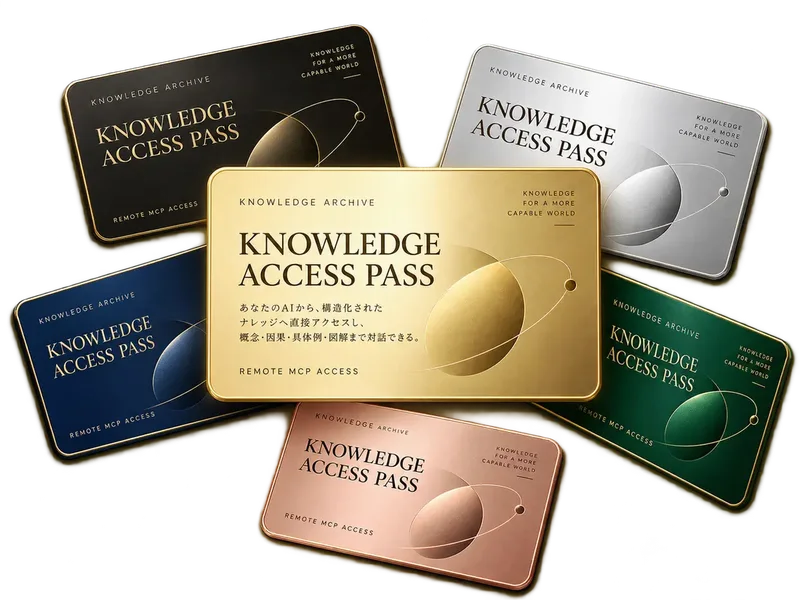
The Network States — Knowledge Access Pass is the second book in the Knowledge Access Pass series, after “Physical AI.” Just as each card has its own color, more books will be added one by one.
AI beginning to act in the physical world, and people beginning to build societies across borders — these may not be separate stories. I hope to grow, little by little, a bookshelf where you can think by moving back and forth between books.
Not only “belonging” to a state, but thinking about what kind of society you want to live in, creating it with others, and choosing again if needed. I invite you to start thinking through that question with your own AI.
KNOWLEDGE ACCESS PASS
Network States — Knowledge Access Pass
An AI connection and access right to the knowledge in “The Idea of Creating a State — "Network States" and the Making of New Societies”
1,000 JPYC or 10 USDC
Tax included, one-time purchase. Network fees for the transfer are separate.
Knowledge Access Pass home (Japanese) ↗Tips (Japanese) ↗About the book
The purchase screens and the Tips page are currently in Japanese only (the product page and guides are available in English). Your AI can talk with you in your own language.