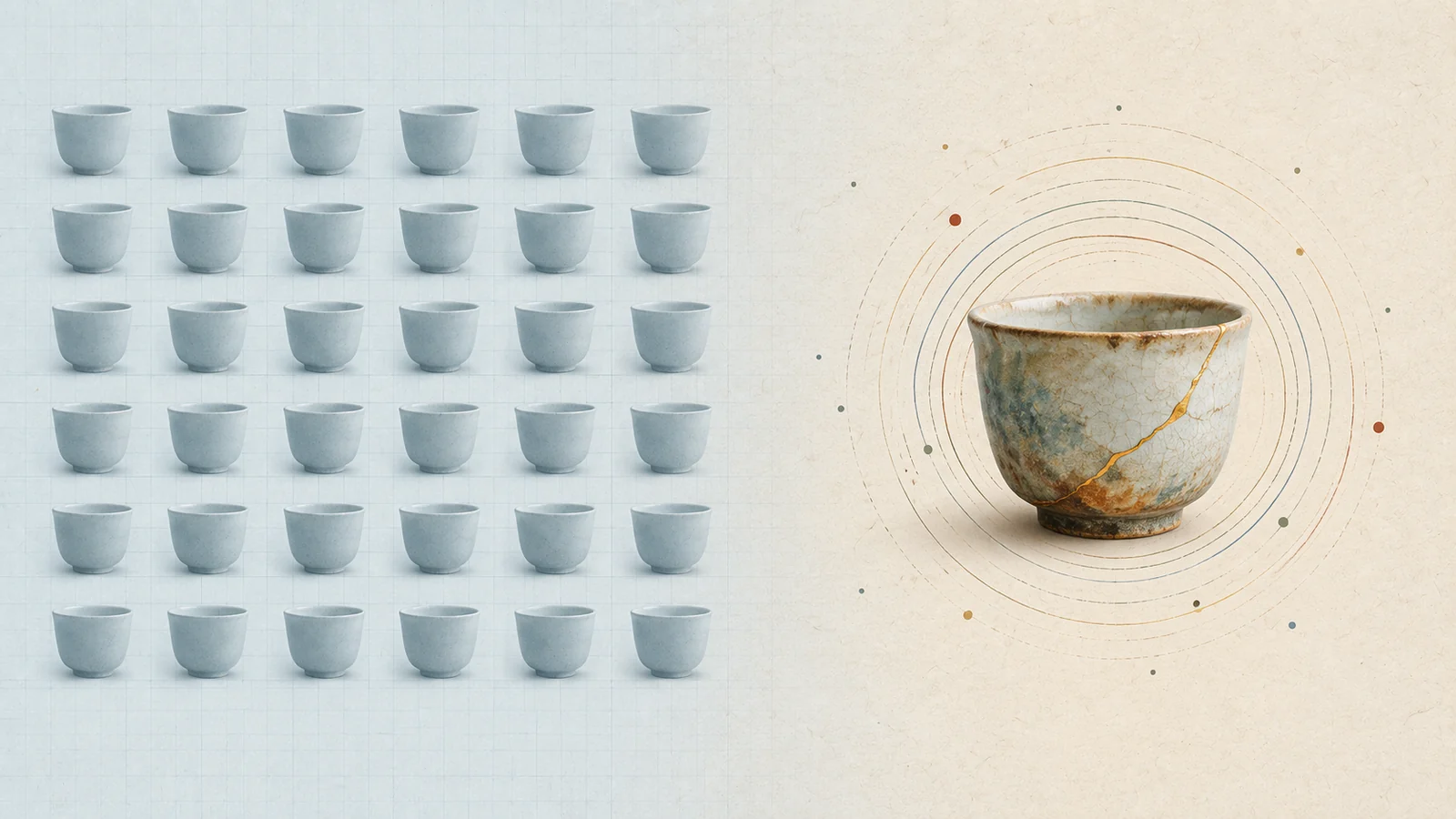
SPECIMEN 00Question
The question
What is beginning to happen is not merely that “AI replaces some jobs.”
Something that has been scarce in human society — the very ability to carry out work — is starting to turn into a replicable resource.
And what gets replicated is not limited to front-line staff who follow instructions and procedures.
Over the next few years, the reach of agents will extend up the hierarchy as well.
Managers who allocate people and budgets.
Supervisors who judge risk and quality.
Strategists who decide what to research, what to invest in, and which markets to enter.
And beyond them, even the roles that design organizations and institutions themselves may come within the reach of agents.
This is not simply a question of “employment.”
What companies and society have treated as scarce resources —
— may lose their scarcity, one after another.
- Information can be copiedCOPY
- Work can be copiedCOPY
- Management can be copiedCOPY
- Judgment and strategy can be copiedCOPY
- Even the functions that run organizations can be copiedCOPY
- Then what is the last thing that cannot be copied?
If we fall back on asking “Which jobs won’t AI take?”, we miss the point.
What I really want to ask is this:
Once function, labor, management and judgment all become far more replicable, where in the world does scarcity remain, and what becomes the root of value?
The further this question goes, the more we have to look not at AI itself but at the side of the real world — time, place, matter, resources, provenance, rights, relationships and the body.
SPECIMEN 01Replication
Replication moves from knowledge to labor — and up the ladder
Before turning to the question of what remains non-replicable, let us first look at how far the wave of replication has already come.
In 2026, agents have moved beyond “information generation” — producing text and images — and the “execution” of defined work is nearing practical maturity. They are beginning to extend into management: allocating people, agents, money and time.
Over the next few years, their reach will climb one level at a time up the hierarchy — into governance, discovery and creation, and even organizational design.
- L5Self-evolution & org designRedesign how work and organizations operate2028–2029+
- L4Discovery & creationFind what should be done and new options2027–2029
- L3GovernanceManage authority, quality, safety and risk2027–2028
- L2Management & allocationAllocate people, agents, money and time2026–2027
- L1ExecutionCarry out work by instruction and procedure2025–2026
- L0Information generationText / images / code / analysis2023–
Reach of agents
Governance = in practice, a control layer needed at every level
In finance, for example, it does not stop with the trader who executes automated trades.
- Trader
- Portfolio manager
- Risk, compliance and approval
- Investment strategy and theme discovery
- Design of funds and markets
Not only the trader — the manager who runs the portfolio, the people who set investment strategy, even the design of funds and markets can increasingly be entrusted to agents.
1.1 Mapping the five stages onto real roles
From the work of staff to the managers, strategy and institutional design above them — what if agents could take all of this on, in every industry and profession…
| Stage | Practical timing | What agents take on | Closest roles in human organizations today | Agent type |
|---|---|---|---|---|
| 1. Execution | 2025–2026 | Carry out defined work | Staff, analysts, developers, traders, operators | Execution agent |
| 2. Management & allocation | 2026–2027 | Allocate people, agents, money, time, inventory and more | Department managers, project managers, portfolio managers, plant managers, store managers | Management & allocation agent |
| 3. Governance | 2027–2028 | Manage authority, quality, safety, risk and approval conditions | Risk management, compliance, quality control, security leads, investment committees | Governance & risk agent |
| 4. Discovery & creation | 2027–2029 | Discover and design new questions, strategies, products, investment themes and markets | Strategists, researchers, product leads, creative directors, R&D heads | Discovery, strategy & creation agent |
| 5. Self-evolution & org design | 2028–2029+ | Redesign organizations, institutions, agent configurations and business systems themselves | Organization designers, system architects, fund designers, institution designers | Organization & institution design agent |
Not that “every profession disappears,” but that “functions open to agents enter many professions, and their scope rises from front-line staff to managers, strategy and institutional design.”
Some may argue that on-the-ground know-how and experience are unique. But once they can be turned into data, they too will eventually be replicated and replaced — as function.
Then what about the tangible — the physical side?
SPECIMEN 02Physical
The physical side can be copied too — but a non-replicable layer remains
Replicability is rising not only for intelligence and labor, but on the physical side as well.
We can already mass-produce the same product by combining parts and materials. As 3D printing, robotics and automated manufacturing advance, the cost of making “something just like it” — including shape, structure and performance — will fall further.
Physical AI extends AI’s output from information to physical action. Robots may increasingly carry out actions such as carrying, making, inspecting, growing and repairing on their own.
Even so, being able to reproduce a physical form or function is different from making the time, place, provenance, relationships and rights that an existence carries the same.
- IntelligenceBecomes easier to copy
- Labor & managementBecomes easier to copy
- Physical actionsMore can be automated
Physical constraints that still remain
- Time
- Space
- Matter
- Energy
- Body
- Resources
- Irreversibility
The more AI and Physical AI advance, the easier it becomes to copy form and function. Paradoxically, the “hard-to-copy layer” that remains beyond form and function may become more visible as a source of value.
SPECIMEN 03Original
Perhaps what cannot be copied is “existence” rather than “form”
Consider, for example, a sword actually used by a historical figure.
Even if the material, shape, scratches and weight could someday be perfectly reproduced, would the replica and the original be worth the same?
OriginalThe individual object that actually passed through that time
- TimeHas passed through centuries
- PlaceExisted in a particular land and place
- EventsWas present at certain events
- ProvenanceWho owned it, and how it was handled
- RelationshipsTies with people and communities
- ContinuityUnbroken all the way to today
Perfect replicaSame form, material and performance
Has not passed through the same time
- Form, material, scratches, weight
- Same
- Same
- Being “that very thing”
- Yes
- No
What cannot be copied here is not necessarily the form.
It may be identity itself — the fact that “this object, as this individual thing, actually passed through that time and that place.”
Framed this way, the same language can describe not only cultural assets, but land, forests, ecosystems, cities, aging, bodies, communities and natural resources.
SPECIMEN 04Non-replicability
Unpacking “non-replicability”
Calling non-replicable value simply “scarcity” is too coarse.
At the very least, it can be broken down as follows.
Select a ring to see its description
Identity
As these accumulate, being “that very thing” rather than “something similar” becomes value in itself.
Time
Time cannot be bought back later by investing money.
A tree grown over 100 years, a company that has lasted 100 years, long aging, a forest ecosystem, the history of a city — no amount of capital can create a century’s worth of them by tomorrow.
Time can be seen as an irreversible input of production.
Place
Land, latitude and longitude, climate, geology and the relationships within a city can be reproduced as images, but the place itself cannot be multiplied.
Matter & resources
Minerals, water, land, energy and biological resources are subject to physical supply limits.
Provenance
The history of who handled something, where, how, and what it passed through does not become identical even if the same path is copied afterward.
Relationships
Human relationships, communities, trust and cultural memory do not become relationships with the same history, however similar their members are made.
Rights
Land, radio spectrum, orbits, ownership, usage rights, revenue rights and access rights carry an institutional scarcity distinct from physical objects.
Identity
As these accumulate, being “that very thing,” rather than “something similar,” becomes value in itself.
SPECIMEN 05Manifestation
Being impossible to copy is not, by itself, value
Not everything that cannot be copied has value.
A stone is not valuable just because it is old, and land no one can use does not necessarily have high value.
Non-replicability is a candidate source of value. Other conditions are needed before it becomes value that society can handle.
- 01Hard to copy
- 02Meaningful
- 03Legible — we can tell what it is
- 04Authenticity, condition and history can be proven
- 05It is clear who can do what
- 06Can be viewed / used / held / joined
- 07Can be transferred / compared / traded
- 08Becomes value society can handle
Infrastructure that brings latent value to the surface
Here, value is considered in at least two layers.
- Sources of value: why something has value in the first place — time, place, scarcity, provenance, relationships, skill, authenticity and so on.
- Conditions that surface value: what makes it possible to find, understand, protect, prove, turn into rights, use and transfer that value.
Mixing the two makes “having value” and “being tradable in a market” look like the same thing.
Physical AI, decentralized crypto infrastructure, provenance proofs, rights management, custody, institutions and markets are not merely tools for reading existing value.
They are better understood as infrastructure for observing latent value, giving it meaning, proving it, preserving it, converting it into rights and usability, and raising it up as value that society can handle.
With this infrastructure in place, things that used to be “valuable but invisible” or “valuable but non-transferable” can, for the first time, become objects of discovery, use, inheritance and exchange.
SPECIMEN 06Allocation
Deciding what is valuable is deciding what world we want
Once we can tell what is hard to copy and what becomes a source of value, the next question arises:
Among all this, what do we want to keep, to nurture, to grow?
Value is not something buried objectively in the world, finished once it is discovered.
Even the same forest is valued differently depending on whether we see it as timber, as an ecosystem, as culture and landscape, or as something to leave for future generations.
Choose a lens
- Timber volume
- Ease of logging
- Biodiversity
- Water and soil
- Carbon storage
- Landscape
- Festivals and faith
- Local memory
- A century of time
- Future options
Future chosenA forest harvested as efficiently as possible
Even the same piece of land leads to a different future depending on whether we convert it to its most profitable use or preserve the history and community found only there.
In other words, beneath every value judgment lies an orientation:
“What kind of world do we want?”
- Observe the world
- Find what is hard to copy
- Understand why it is valuable
- Consider what world we want to leave
- Decide what to protect / nurture / open / grow
- Allocate time, people, capital, technology and energy
At this point, resource allocation is no longer mere efficiency.
Resource allocation becomes the act of gradually moving reality toward the world we want.
And if agents come to handle not only execution but research, evaluation, management and discovery, they will enter this domain too.
Actors that discover value and allocate resources
- 01Research value
- 02Evaluate value
- 03Compare options
- 04Allocate resources
- 05Protect / nurture / open to markets
- 06Discover the next value
In finance, this leads to agent finance.
But its essence is not “having AI trade stocks.”
It lies in judging where in the world hard-to-copy value exists and what we want to leave for the future, and allocating resources — including capital — there.
What agents need for that is more than price data.
World
Becoming easier to copy
- Information
- Functions
- Labor
- Parts of management and judgment
Hard to copy
- Time
- Place
- Matter & resources
- Provenance
- Relationships
- Rights
- Identity
- What world do we want?
- World model
- Value judgment
- Resource allocation
- Capital allocation
So the important question is
not “What should we have AI buy?” but “What world do we want, what do we recognize as valuable for it, and where do we allocate resources?”
The evolution of agents is not only the automation of labor; it also means more actors that discover value and allocate resources along the direction of the world.
SPECIMEN 07Valuetize
Not monetizing, but “valuetizing” — building worlds from value
Having come this far, the last remaining question is not “What makes money?”
Nor is valuetizing just about finding value within the existing world and connecting it to markets.
It extends to creating entirely different worlds from combinations of value that never existed before.
AI copies knowledge.
Agents copy labor.
Manager agents allocate people, money and time.
Discovery agents generate even new questions and options.
Physical AI extends all this into actions in the real world.
What matters then is the question:
What still cannot be copied, what has value, and to which future do we connect that value?
For a long time I have thought not in terms of “monetizing,” but in terms of “valuetizing.”
If monetizing is converting value the market already recognizes into revenue and profit, valuetizing is much broader.
Things that have no price yet.
Things markets cannot evaluate well.
Relationships, culture, time, experience, trust, beauty, stories, the environment, community.
Things that are hard to exchange now, but may look important from the future.
To take these and
- Find them
- Give them meaning
- Protect / nurture them
- Give them a form others can share
- Connect them to rights, institutions and markets when needed
- Combine new relationships, cultures, economies and governance
- Build worlds that have never existed before
— all of this is what I mean by valuetizing.
Valuetizing is not just the “discovery” of value.
Starting from value that existing markets and institutions could not handle, it is also assembling new contexts, new relationships, new economies, new governance and new cultural spheres.
So the final unit of valuetizing is not a “product” or a “business,” but in some cases a world itself.
That is why monetizing can be part of valuetizing, but valuetizing does not fit inside monetizing.
Monetization can be part of valuetizing, but valuetizing does not fit inside monetization.
Value
Actions
- Preserve
- Nurture
- Share
- Institutionalize
- Connect to markets
- Recompose into new contexts
Build new worlds
- New cultures
- New economies
- New governance
- New relationships
- New spaces & worldlines
Becoming a multiverse
Monetizeone possible exit, when needed
So where does valuetizing begin?
Not by asking “what to sell” within existing markets.
Put the world you want first, find the value that world needs, and connect it to reality. And if necessary, rather than fitting into existing reality, build the new world in which that value holds.
And in the age of agents, this order of thinking may become more realistic than before.
If much of execution, management, research, production and capital allocation can be handed to agents, humans can work further upstream, thinking about
What do we regard as valuable?
What world do we want?
What do we leave to the future?
and hand those judgments to groups of agents and to capital.
The more replicable labor becomes, the less certain it is that human value disappears.
Rather, we may be able to widen once more a view of value that has been confined within jobs and markets.
- Labor is replicated
- The map of scarcity changes
- We revisit the sources of value
- We decide what world we want
- We find, nurture and connect value
- Valuetizing
- We assemble new contexts, economies, governance and cultures
- We change the existing world / build other worlds
- Multiple worldlines coexist
What remains in the end is
not “What can we monetize?” but
“What do we discover as valuable, and how do we build a world in which that value lives?”
— that, I think, is the question.
What lies beyond valuetizing is not a single correct world.
From different values, worlds with different cultures, economies, governance and relationships emerge — coexisting, connecting and influencing one another.
Perhaps valuetizing is not about turning value into money,
but about multiplying worlds from value.