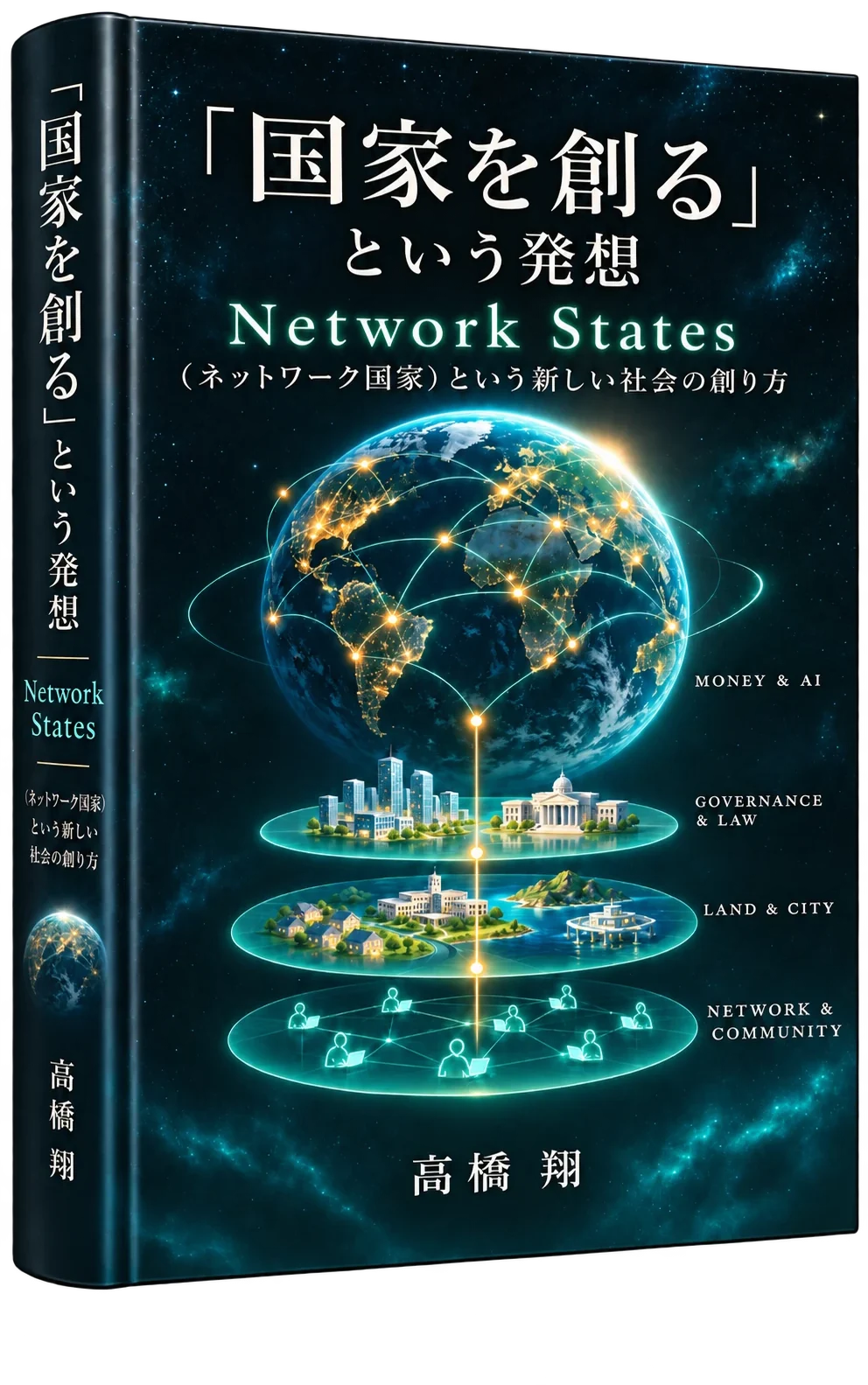
People who meet across borders on the internet form a community first, then put together funding, land and institutions. How far have such attempts become reality? The book examines them through practice around the world and national laws and documents.
* This book is written in Japanese (sold on Amazon.co.jp).
Structure
Prologue + 34 chapters in 8 parts
Format
Amazon Kindle (Japanese)
About this Book
Here is what is happening in the world right now.
Liberland2015
Near a border along the Danube, a man declared the founding of a new state, “Liberland”. Its proponents still claim that it meets the requirements of statehood.
HondurasPróspera
“Próspera”, a special-zone city run by a private company with its own rules, came into being. After the Supreme Court ruled the zone system unconstitutional, the operator maintained that its rights continue, and the dispute has gone on to criminal complaints by the state and international arbitration.
RoatánLongevity research
On this island, home to Próspera, people seeking to accelerate longevity research have gathered, and an early-stage clinical trial of a gene therapy has also been registered.
Marshall IslandsDAO
The Marshall Islands in the Pacific set up a system under which DAOs (organizations on a blockchain) that operate across borders can be registered as legal entities.
Kazakhstan2026
A constitutional law was enacted for “Alatau City”, a city with a special legal regime. In the same year, cooperation was also announced between government-related bodies of the country and “Network School”, a school started by Balaji Srinivasan, who proposed the Network State idea.
El Salvador2021 / 2025
It made bitcoin legal tender in 2021, and in 2025 revised the obligation to accept it.
* Each of these cases is discussed in detail in the book, with sources.
They look like unrelated news, but they are connected by a single current: people who come together across borders on the internet form a community first, then assemble funding, land and institutions — a movement known as Network States.
From a small experiment in Montenegro in 2023, where about 200 people lived together for about two months, to disputes involving national law and international arbitration — attempts of very different scale and character sit within the same current.
Is this the birth of new countries? Enclaves for the wealthy? Or is the very way societies are made beginning to change?
How this Book Reads
Keeping what exists apart from what is envisioned.
Drawing across practice around the world in 2025 and 2026, national laws and documents from international organizations, the book approaches this question while keeping three things apart.
Established
What has been achieved
Things that can be confirmed from sources: laws that have been enacted, systems that now allow registration, periods of shared living that actually took place.
Vision
What participants envision
The plans, goals and claims of proponents and operators. The book treats them separately from what has been achieved.
Open Questions
What is not yet confirmed
Effects and future shapes that cannot yet be judged. The book sets different views side by side and does not rush to conclusions.
This is not a manual for building a country. It examines how new societies come into being, where they come to terms with states and laws, and which questions remain open — setting differing views side by side.
The same technologies can lead to a future where freedom expands — or one where power concentrates.
In this book, “Network State” refers to the idea proposed by Balaji Srinivasan. “Network States” refers to the wider movement around it — shaping new societies out of networks that cross borders. It does not mean that every community is already a state in the legal sense.
Themes
From communities to money, AI and everyday life.
Is the power to build societies beginning to pass from states and giant companies into the hands of people who can bring others together, too? The book traces that shift through the following themes.
CommunityPart II
How communities are born, spread and split
Land / LawParts III–IV
How they come to terms with land, housing, citizenship and law — and what changes when they partner with states
MoneyParts IV–V
Decision-making through DAOs, stablecoins, tokenization of assets, financial privacy
AIPart VI
When AI and AI agents take on the administration and business of small communities
LifePart VII
How education, health, culture and family life might change
Ideas / FuturesParts I & VIII
Where the idea started and its place in history, a comparison of competing models, and future scenarios offered as hypotheses
Contents
Contents (Prologue + 34 chapters in 8 parts)
Tap a part to see its chapter and section headings. (Headings are translated; the book itself is in Japanese.)
PrologueEntryWho can build a society?+
PrologueWho Can Build a Society?
0-1What is a Network State? — People gather first, then build places and institutions
0-2Why now? — How networks, currency, DAOs and AI change the “power to build societies”
0-3How far have the ideas become reality? — From shared living to collaboration with states
0-4The other face of the revolution — Will people's freedom expand?
0-5Imagining societies that don't yet exist — Questions about the future
PART IIdeas, visions and historyWhat are Network States? Their place amid changes in states and the world order.+
Ch. 1What Is a Network State?
1-1Balaji Srinivasan's vision of the Network State
1-2The conditions for statehood and forming societies from networks
1-3How Network State, Network Society and Network City differ
1-4Relations with sovereign and existing states, and multiple definitions
Ch. 2The Vision of Building Societies from the Internet
2-1From Internet Company to Internet Currency and Internet Community
2-2Organizing people, capital and trust through networks
2-3Reforming existing institutions, or creating new ones
2-4What it means for the online and physical worlds to connect
Ch. 3How Are States and the World Order Changing?
3-1Technological innovation and historical change in states
3-2Globalization, multipolarity and competition between states
3-3The World Building perspective of Bruno Maçães and others
3-4Competing views: states declining, being reorganized, or growing stronger
Ch. 4What Are Network States Trying to Achieve?
4-1Expanding freedom, choice and autonomy
4-2Experiments and innovation in new social institutions
4-3New ways of forming economic, living and cultural spheres
4-4Networking and decentralization are not necessarily the same
PART IIFormation, growth and expansionHow communities emerge from networks, spread as physical bases and branch off.+
Ch. 5How Do Communities Emerge from Networks?
5-1Coming together around a shared vision, values and culture
5-2Community formation and network effects
5-3Membership, conditions for joining and identity
5-4Moving beyond a mere online community
Ch. 6The Society-Building Power of Media, Creators and Platforms
6-1Creators and distributed influence
6-2Social infrastructure such as Farcaster, Telegram and TON
6-3Journalism, discourse, reputation and trust
6-4From content to communities, economies and the real world
Ch. 7From Pop-up Cities to Lasting Societies
7-1Zuzalu, Edge City, Zuitzerland — places for prototyping society
7-2The difference between short stays and long-term settlement
7-3ârc, The Mu, 4Seas, Noma Collective and other developments
7-4What makes the transition to a lasting base and society possible?
Ch. 8Replicating, Forking and Networking Communities
8-1Forks of DAOs, protocols and organizations
8-2Lessons from how long-lived organizations are passed on
8-3Mechanisms that link multiple bases and communities
8-4What can be replicated and what must be passed on
PART IIIImplementation in the physical worldPartnerships with states, special zones, land, residence and citizenship. New models of cities and states.+
Ch. 9There Is More Than One Way to Implement Network States
9-1Liberland, Próspera, Seasteading
9-2Pop-up communities, Network School and permanent bases
9-3Industry- and purpose-specific models such as Alpha City and Oz City
9-4Institutional differences among cities, special zones, states and private communities
Ch. 10Partnerships Between Existing States and Network States
10-1Models of coexistence and collaboration between the Network and the Nation State
10-2Kazakhstan and Network School
10-3Alatau City's urban vision, legal framework and tokenization plans
10-4What partnering with a state makes possible, and the constraints that remain
Ch. 11New Markets Created by States, Local Governments and Special Economic Zones
11-1El Salvador's Bitcoin policy
11-2Singapore's urban and industrial infrastructure
11-3Regulatory and urban models such as Dubai Expo City and ADGM
11-4Where national policies, including Suriname's, meet network societies
Ch. 12Land, Real Estate, Infrastructure and Local Communities
12-1Conditions for acquiring and operating land and physical facilities
12-2Housing, industrial and urban infrastructure, and public goods
12-3Relations with existing residents, local economies and the commons
12-4Models for newcomers and existing communities to coexist and create together
Ch. 13Talent, Residence and Citizenship Across Borders
13-1Global Mobility and the Passport Portfolio
13-2The reality of multiple residencies, nationalities and choosing a state
13-3Practices such as CitizenX and Henley & Partners
13-4The freedom to Exit, and conditions for families, children and those who can't move
PART IVGovernance, institutions and sustainabilitySovereignty and law, decision-making, Exit and Voice, and how institutions are passed on and end.+
Ch. 14Network States and Sovereignty, Law and Institutional Design
14-1State recognition, autonomy, regulatory authority and contractual rights
14-2Special zones, autonomous cities and DAO legislation
14-3The differences between an MOU, enactment, entry into force, operation and track record
14-4Dividing authority between existing states and new governing bodies
Ch. 15New Governance and Decision-Making Mechanisms
15-1DAOs, token governance and community governance
15-2How the powers of members, asset holders and residents differ
15-3Founders, operating organizations and informal power structures
15-4Rule changes, consensus building, responsibility and remedies
Ch. 16Exit, Voice, Competition and the Public Interest
16-1What does being able to choose a state change?
16-2How Exit and Voice complement and conflict with each other
16-3Bearing the cost of public goods, externalities and giving back locally
16-4The rights of non-members, minorities and existing residents
Ch. 17How Do Societies and Institutions Endure and Evolve?
17-1Passing an organization on beyond its founders
17-2Forkable institutions and physical assets that can't move
17-3The continuity of states that have lost territory, and digital statehood
17-4Making institutions last, changing them, and ending them reasonably
PART VEconomy, finance and capital marketsCurrency, payments, privacy, tokenization and how economies are measured.+
Ch. 18A New Relationship Between States and Currency
18-1Bitcoin, public finances and national strategy
18-2The Multicurrency Economy and currency competition
18-3Community economies built on crypto assets
18-4Does currency need to be tied to the state?
Ch. 19Payments, Stablecoins and Digital Financial Infrastructure
19-1The visions of Circle, Paxos and others
19-2Moving value across networks
19-3Stablecoins, financial regulation and reserve assets
19-4Conditions for a means of payment to become social infrastructure
Ch. 20Privacy, Cryptography and Free Money
20-1The ideas behind Zcash and private money
20-2Zero-Knowledge Proofs, technical progress and scalability
20-3Resistance to surveillance, access to finance and selective disclosure
20-4Confidentiality, oversight and security: competing and coexisting
Ch. 21Asset Tokenization and New Models of Ownership and Investment
21-1Tokenization, Digital Assets and RWA
21-2Tokenized stocks, underlying assets, custody and legal rights
21-3Cities, real estate, infrastructure and the financialization of assets
21-4Distributing value to investors and local communities
Ch. 22Growth, Investment and Valuation in the Network Economy
22-1Capital formation, VCs, investors and the founder ecosystem
22-2GDP, population, network size and reputation metrics
22-3Measuring short stays, settlement, employment and economic effects
22-4Is economic size the same as social success?
PART VIAI, blockchain and foundational technologyBlockchains, AI agents, cryptography, and AI and state power.+
Ch. 23Social Infrastructure Built on Blockchain
23-1Ecosystems such as Ethereum, Solana, Base and TON
23-2Decentralized identity, transactions, services and ownership
23-3Interoperability and programmable economies
23-4Conditions under which protocols support community formation
Ch. 24AI, AI Agents and Running Society
24-1AI and the democratization of software development
24-2Running organizations and services with AI agents
24-3Verifiable computation, and the authority and limits of agents
24-4Decisions that can be delegated to AI, and the responsibility that stays with humans
Ch. 25The Evolution of Cryptography, Security and Technical Foundations
25-1Zero-Knowledge, formal verification and mathematical assumptions
25-2Cryptography in the age of quantum computing
25-3How AI and cryptography interact
25-4Technical security and trust in social institutions
Ch. 26The Future of AI, States, the Economy and Power
26-1The future hypothesis of an AI Empire
26-2Concentration of compute, data and state power
26-3AI-driven economic growth, employment and income distribution
26-4Will AI make Network States possible, or strengthen existing states?
PART VIIEducation, health, culture and ways of livingSchools, longevity, religion and culture, and how people live.+
Ch. 27Network States and Education and Talent Development
27-1The vision and practice of Network School
27-2The 1517 Fund and objections to the existing education system
27-3Different education models such as UATX and Fractal
27-4The potential of schools, research and talent to anchor community formation
Ch. 28Health, Longevity, Biotechnology and Living Spaces
28-1Infinita and longevity-oriented communities
28-2Longevity research and plans for social implementation by Bryan Johnson and others
28-3Designing the body, sleep, behavior and living environment
28-4Institutions, safety and ethics of medical research, and new societies
Ch. 29Religion, Culture, Values and the Identity of Societies
29-1Seeing religion as a precedent for the Network State
29-2Culture, tradition, community cohesion and continuity
29-3The social pull created by creators, stories and symbols
29-4Shared values versus diversity, dissent and exclusivity
Ch. 30How Will Network States Change the Way People Live?
30-1Redesigning work, housing, family and relationships
30-2Local communities and long-term social capital
30-3Freedom, happiness, the good life and views on life and death
30-4New possibilities: “choosing,” “building” and “nurturing” a society
PART VIIICross-cutting analysis and visions of the futureReading the changes, competing models, cross-cutting visions and future scenarios.+
Ch. 31How Should We Read the Changes in Network States?
31-1Changes in the main issues and visions over two years
31-2Year-on-year comparisons of Edge City, Ipê City, ârc, Base and others
31-3Movements in government partnerships, permanent bases, finance and AI
31-4What has advanced, what hasn't changed, and what can't yet be confirmed
Ch. 32Competing Models of How Network States Form and Develop
32-1Network-first, city-first, industry-first and state-collaboration-first
32-2Competing models such as Exit, Commons and institutional continuity
32-3The conditions under which each model works or breaks down
32-4Can Network States be explained by a single path of development?
Ch. 33A New Vision Seen Across Multiple Fields
33-1New combinations of Network × Physical World × Institutions
33-2How AI × Blockchain × Governance changes the running of society
33-3Forming new economies through Capital × Community × Culture
33-4The possibility of new social models beyond Network States
Ch. 34Future Scenarios and Future Research and Implementation
34-1Multiple future scenarios in which Network States expand
34-2Possibilities of coexistence, competition and integration with existing states
34-3New markets that may arise in institutions, industry, finance and culture
34-4Hypotheses to test, key open questions and points to watch
For Readers
Who it's for.
Entrepreneurs and builders
For those who want to understand efforts to gather people and money across borders and launch bases and ventures — including the institutional side.
People in government and community development
For those who want to think about special zones, new cities and policies to attract people from abroad, from the viewpoint of the side that hosts or partners.
Educators and researchers
For those who want to compare how communities form and govern themselves, and new attempts at schools, based on cases and sources.
Anyone interested in the future of crypto and AI
For those who want to consider how DAOs, stablecoins and AI agents might take part in running societies — looking at both the possibilities and the risks.
People who want to rethink the state and power
For readers interested in anarchism or libertarianism who want to see how far order and self-government without relying on the state actually hold up in real experiments.
Artists, writers and creators
For those who want to depict societies and communities that do not yet exist, through works, stories or the making of places. Real experiments can be clues for the imagination.
It offers a way of looking at things for thinking about what kind of society you want to live in, building it with others, and choosing again if needed.
Knowledge Access Pass
Explore the book's knowledge with your own AI.
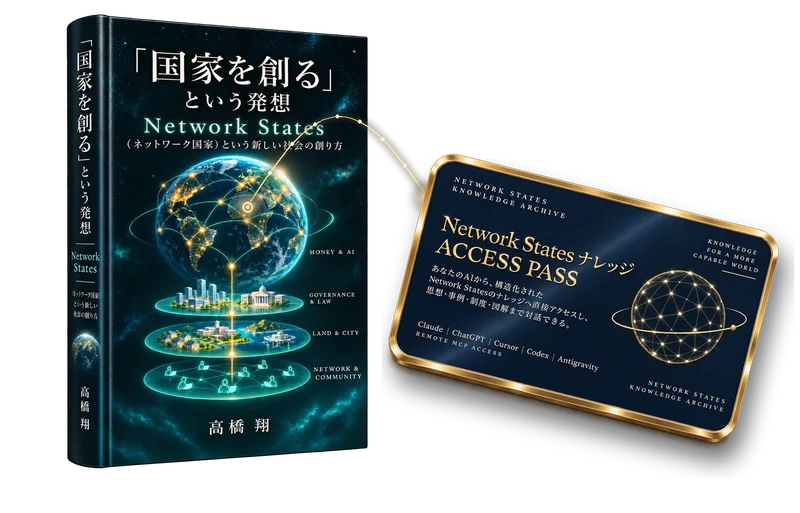
There is also the “Network States — Knowledge Access Pass”, which connects the book's knowledge to your own AI so you can explore it. Starting from any theme that interests you, you can move across ideas, examples, institutions and chapters and deepen your thinking.
1,000 JPYC or 10 USDCTax included, one-time purchase
What you buy is an access right (MCP access) for your AI to connect to the book's knowledge. It is not a sale of the book's text or a PDF.
A Futurist who produces the conditions under which a future can come true — envisioning the future beyond irreversible change, backcasting from it to the present, and working across technology, business, institutions, capital, culture, and space.
He spent 11 years in new business and business development at NTT East. Since then, he has continued to connect ideas to business and society across very different positions — companies, industry associations, universities, and technology communities.
He is currently Representative Director of the AI&NoCoders Japan Association, CINO (Chief Innovation Officer) of Pressman Co., Ltd., Visiting Professor at iU (Professional University of Information and Management for Innovation), and Co-Founder of ICP Japan.
In this book, he describes why the idea of people creating something like a state themselves has begun to seem realistic now, and reads its ideas and practice in terms of both their possibilities and their risks.
What kind of book is “The Idea of Creating a State”?
It examines the movement known as “Network States”, in which people who come together across borders on the internet first form a community and then assemble funding, land and institutions. Across a prologue and 34 chapters in 8 parts — ideas, community formation, implementation in the physical world, governance, economy, technology, ways of living and visions of the future — it keeps what has been achieved, what participants envision and what is not yet confirmed separate.
Is it a step-by-step guide to founding a new country?
No. It is not a how-to manual. It examines how new societies come into being, where they come to terms with states and laws, and which questions remain open — setting cases, sources and differing views side by side.
Is it a commentary on Balaji Srinivasan's “The Network State”?
No. It does cover the proponent's idea, but rather than explaining one person's vision, it follows the practices spreading around the world in its orbit. The book uses “Network State” for the proponent's idea and “Network States” for the wider movement.
Where can I read it?
It is available on Amazon Kindle (in Japanese). Please check the Amazon product page for the price and Kindle Unlimited availability.
Who is the author?
Sho Takahashi (Sho T). After 11 years in new business and business development at NTT East, he now works as a Futurist: Representative Director of the AI&NoCoders Japan Association, CINO of Pressman Co., Ltd., Visiting Professor at iU (Professional University of Information and Management for Innovation), and Co-Founder of ICP Japan.
Read on Kindle
Into whose hands is the power to build societies passing?
“The Idea of Creating a State” is available on Amazon Kindle (in Japanese). Please check the Amazon product page for the price and Kindle Unlimited availability.