Sho T KNOWLEDGE

From belonging to a state to the idea of creating one.

An AI connection and access right to a book's knowledge

Network States —
Knowledge Access Pass

What is “knowledge access”?A service that connects the knowledge in the book “The Idea of Creating a State — ‘Network States’ and the Making of New Societies” to your own AI so you can explore it. Starting from any theme that interests you, you can move across ideas, examples, institutions and chapters and deepen your thinking together.

What you buy
You are buying an access right (MCP access) for your AI to connect to the book's knowledge.
Not included
This is not a sale of the book's text, a PDF or a physical card.

The purchase screens, your account page, the Tips page and the legal pages are currently in Japanese only. Your AI can talk with you in your own language.

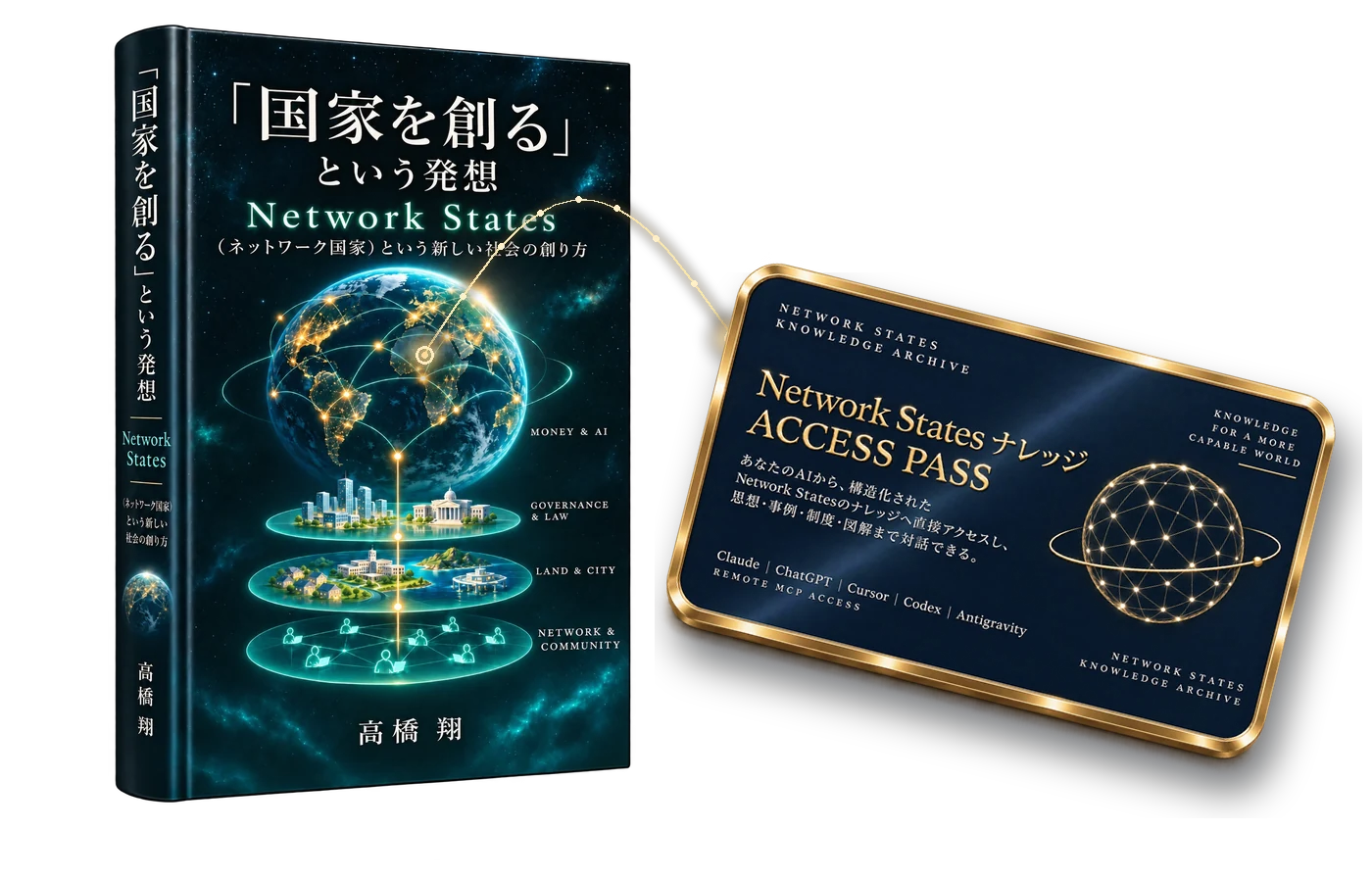
The book “The Idea of Creating a State” and the navy Knowledge Access Pass card, linked by a line of light. No physical card is shipped.

The book's knowledge → to your AI

*This is not a sale of a physical card. It is a sale of an access right (MCP access) for your AI to connect to the book's knowledge.

1,000 JPYCor10 USDC

Either option: tax included, fixed amount, one-time purchase

See how to buy (opens in a new tab) ↗
Preparation, guarantee and personal data before you buy
Service guaranteed for at least 3 months from purchase

It does not stop working automatically after 3 months. You can keep using it as long as the service continues, but provision is not guaranteed forever.

No name, email address or password needed

We never hold your wallet's private key or recovery phrase. We do handle your wallet address and the order, payment and authentication records needed to manage purchases and use.

What you need before buying
① A supported wallet app (phone / PC)② JPYC or USDC + the network fee for the transfer③ An AI that can set up MCP connections (when using)

Supported wallet apps and transfer networks are shown on the purchase screen.Check requirements and preparation ↗

Guarantee
Service guaranteed for at least 3 months from the date of purchase
Networks
Ethereum, Polygon, Avalanche
Choose the network and currency when you buy.
Fees
The network fee for the transfer (gas) is required separately.
USDC
The yen value of 10 USDC is not guaranteed to equal 1,000 yen.

TWO WAYS TO EXPLORE

Reading a book and talking with its knowledge through AI
are different experiences.

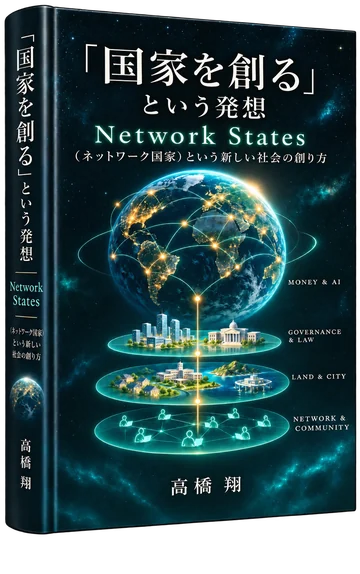
Cover of the book “The Idea of Creating a State”BookTake in the author's words closely.Read the text and build understanding along its structure.The book is on sale at Amazon (Kindle, Japanese) ↗About the book →
+
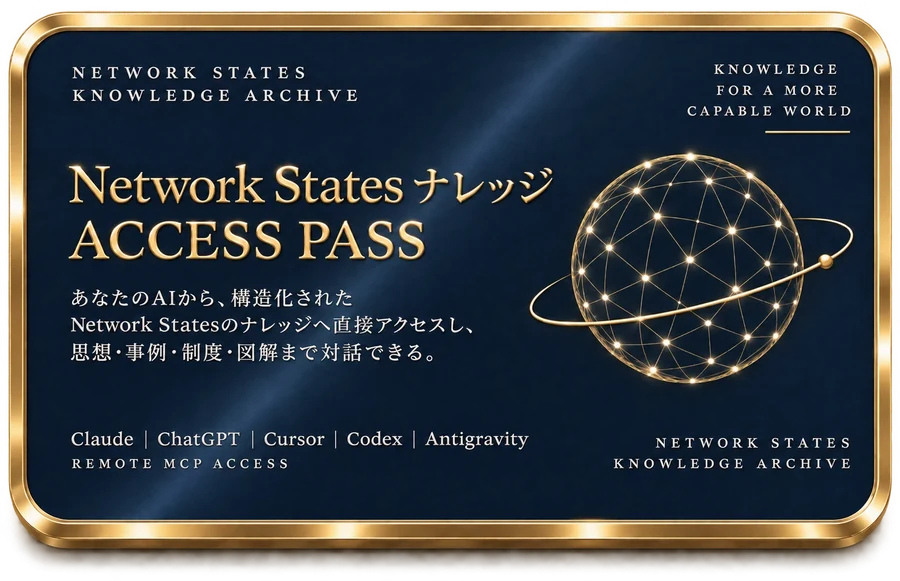
The navy card of the Network States — Knowledge Access PassAccess Pass (the product on this page)Explore the knowledge from your own questions.Ask across chapters and deepen your own thinking.Buy the Access Pass (Japanese) →*This is not a sale of a physical card. It is a sale of an access right (MCP access) for your AI to connect to the book's knowledge.

About this book

What does “The Idea of Creating a State — ‘Network States’ and the Making of New Societies”
describe?

Beyond simply “belonging” to a state, can people gather first and then “create” places and institutions? Starting from the ideas and history of Network States, the book connects community formation, partnerships with states, governance and institutions, currency and finance, AI and blockchain, and education, health and culture, and sets competing views and future scenarios side by side.

What makes this book distinctive is that it reads visions separately from what has actually come into being. Connect it to your AI with the Access Pass, and you can ask from your own interests and check links to other chapters, examples and opposing views in the book.

GET STARTED

From purchase to talking with it through your AI.

What happens after you buy is simple.

01Buy with your wallet

After a free identity-check signature, pay with JPYC or USDC.

02Go to your page

Once payment is confirmed, check your access right and connection code.

03Connect your AI

Register the connection in ChatGPT, Claude or another AI and authorize it.

04Talk with the book's knowledge

Trace the links between the ideas, examples and institutions that interest you, together with your AI.

EXPLORE THE BOOK

What kind of dialogue can you have
with this book's knowledge?

When you ask your AI, you can deepen your thinking together, using the book's ideas and examples as clues and tracing related issues and opposing views.

For example, starting from questions like these

The buttons above switch between examples. In practice, you ask whatever you like, and your AI thinks it through with you by tracing the book's knowledge.

✳
Exploring with AIIllustrative conversation, not a live response
Will there be a time when we can switch the country we live in, like a phone plan?

The book introduces families who combine permanent residence, long-stay permits and citizenship for different purposes, while checking that each status carries different rights and duties. Having the option to move is not the same as being able to settle somewhere. And the more choices mobile people have, the book asks what is left for people and places that cannot move.

Related: Ch. 13, sections 13-1 and 13-4; Ch. 16, sections 16-1 and 16-2
Check the chapters and sections behind it, then move on to your next question.

BOOK CONTENTS × QUESTIONS

Trace the whole book
from the questions you care about.

People who met on the internet are forming communities first and trying to obtain land, money and rules afterwards. This book follows that movement through real cases around the world and tells apart what has already happened from what is still only a plan. We have added examples of questions you could ask your AI to the actual table of contents. Look over every chapter title and tap the ones that interest you.

Contents and example questions Prologue + 34 chapters (8 parts)

All chapter titles are shown. Use “See sections & an example question” to check what's inside. (Chapter titles are translated from the Japanese book.)

The Prologue and all 34 chapters. Open “See sections & an example question” on any chapter to see its sections and an example of a question you could ask your AI.

EntryPrologue
Who can build a society?
PrologueWho Can Build a Society?See sections & an example question +

Sections in this chapter

  • 0-1 What is a Network State? — People gather first, then build places and institutions
  • 0-2 Why now? — How networks, currency, DAOs and AI change the “power to build societies”
  • 0-3 How far have the ideas become reality? — From shared living to collaboration with states
  • 0-4 The other face of the revolution — Will people's freedom expand?
  • 0-5 Imagining societies that don't yet exist — Questions about the future
Example question for your AI: “What perspective does this book take on Network States?”
Ideas, visions, historyCh. 1–4
What Network States are, and where they stand amid changes in states and the world order.
Ch. 1What Is a Network State?See sections & an example question +

Sections in this chapter

  • 1-1 Balaji Srinivasan's vision of the Network State
  • 1-2 The conditions for statehood and forming societies from networks
  • 1-3 How Network State, Network Society and Network City differ
  • 1-4 Relations with sovereign and existing states, and multiple definitions
Example question for your AI: “How do a Network State, a Network Society and a Network City differ?”
Ch. 2The Vision of Building Societies from the InternetSee sections & an example question +

Sections in this chapter

  • 2-1 From Internet Company to Internet Currency and Internet Community
  • 2-2 Organizing people, capital and trust through networks
  • 2-3 Reforming existing institutions, or creating new ones
  • 2-4 What it means for the online and physical worlds to connect
Example question for your AI: “How does the vision of building societies from the internet connect to the history of companies and currencies?”
Ch. 3How Are States and the World Order Changing?See sections & an example question +

Sections in this chapter

  • 3-1 Technological innovation and historical change in states
  • 3-2 Globalization, multipolarity and competition between states
  • 3-3 The World Building perspective of Bruno Maçães and others
  • 3-4 Competing views: states declining, being reorganized, or growing stronger
Example question for your AI: “Will states decline, be reorganized, or grow stronger? What views does the book set side by side?”
Ch. 4What Are Network States Trying to Achieve?See sections & an example question +

Sections in this chapter

  • 4-1 Expanding freedom, choice and autonomy
  • 4-2 Experiments and innovation in new social institutions
  • 4-3 New ways of forming economic, living and cultural spheres
  • 4-4 Networking and decentralization are not necessarily the same
Example question for your AI: “Why are networking and decentralization not the same thing?”
Formation, growth, expansionCh. 5–8
How communities emerge from networks, spread as bases and branch off.
Ch. 5How Do Communities Emerge from Networks?See sections & an example question +

Sections in this chapter

  • 5-1 Coming together around a shared vision, values and culture
  • 5-2 Community formation and network effects
  • 5-3 Membership, conditions for joining and identity
  • 5-4 Moving beyond a mere online community
Example question for your AI: “What does it take for an online community to become a real community?”
Ch. 6The Society-Building Power of Media, Creators and PlatformsSee sections & an example question +

Sections in this chapter

  • 6-1 Creators and distributed influence
  • 6-2 Social infrastructure such as Farcaster, Telegram and TON
  • 6-3 Journalism, discourse, reputation and trust
  • 6-4 From content to communities, economies and the real world
Example question for your AI: “How do creators and platforms become a power for building society?”
Ch. 7From Pop-up Cities to Lasting SocietiesSee sections & an example question +

Sections in this chapter

  • 7-1 Zuzalu, Edge City, Zuitzerland — places for prototyping society
  • 7-2 The difference between short stays and long-term settlement
  • 7-3 ârc, The Mu, 4Seas, Noma Collective and other developments
  • 7-4 What makes the transition to a lasting base and society possible?
Example question for your AI: “What changes when a Pop-up City moves toward a lasting society?”
Ch. 8Replicating, Forking and Networking CommunitiesSee sections & an example question +

Sections in this chapter

  • 8-1 Forks of DAOs, protocols and organizations
  • 8-2 Lessons from how long-lived organizations are passed on
  • 8-3 Mechanisms that link multiple bases and communities
  • 8-4 What can be replicated and what must be passed on
Example question for your AI: “When a community is replicated or forked, what can't be copied?”
Implementation in the physical worldCh. 9–13
Partnerships with states, special zones, land, residence and citizenship. New models of cities and states.
Ch. 9There Is More Than One Way to Implement Network StatesSee sections & an example question +

Sections in this chapter

  • 9-1 Liberland, Próspera, Seasteading
  • 9-2 Pop-up communities, Network School and permanent bases
  • 9-3 Industry- and purpose-specific models such as Alpha City and Oz City
  • 9-4 Institutional differences among cities, special zones, states and private communities
Example question for your AI: “How do Liberland, Próspera and Network School differ as institutions?”
Ch. 10Partnerships Between Existing States and Network StatesSee sections & an example question +

Sections in this chapter

  • 10-1 Models of coexistence and collaboration between the Network and the Nation State
  • 10-2 Kazakhstan and Network School
  • 10-3 Alatau City's urban vision, legal framework and tokenization plans
  • 10-4 What partnering with a state makes possible, and the constraints that remain
Example question for your AI: “What does partnering with an existing state make possible, and what constraints remain?”
Ch. 11New Markets Created by States, Local Governments and Special Economic ZonesSee sections & an example question +

Sections in this chapter

  • 11-1 El Salvador's Bitcoin policy
  • 11-2 Singapore's urban and industrial infrastructure
  • 11-3 Regulatory and urban models such as Dubai Expo City and ADGM
  • 11-4 Where national policies, including Suriname's, meet network societies
Example question for your AI: “How have states and special economic zones created new markets?”
Ch. 12Land, Real Estate, Infrastructure and Local CommunitiesSee sections & an example question +

Sections in this chapter

  • 12-1 Conditions for acquiring and operating land and physical facilities
  • 12-2 Housing, industrial and urban infrastructure, and public goods
  • 12-3 Relations with existing residents, local economies and the commons
  • 12-4 Models for newcomers and existing communities to coexist and create together
Example question for your AI: “How can a new base coexist with the people who already live there and the local economy?”
Ch. 13Talent, Residence and Citizenship Across BordersSee sections & an example question +

Sections in this chapter

  • 13-1 Global Mobility and the Passport Portfolio
  • 13-2 The reality of multiple residencies, nationalities and choosing a state
  • 13-3 Practices such as CitizenX and Henley & Partners
  • 13-4 The freedom to Exit, and conditions for families, children and those who can't move
Example question for your AI: “What does being able to choose where to live across borders mean for families and for people who can't move?”
Governance, institutions, sustainabilityCh. 14–17
Sovereignty and law, decision-making, Exit and Voice, how institutions are passed on and end.
Ch. 14Network States and Sovereignty, Law and Institutional DesignSee sections & an example question +

Sections in this chapter

  • 14-1 State recognition, autonomy, regulatory authority and contractual rights
  • 14-2 Special zones, autonomous cities and DAO legislation
  • 14-3 The differences between an MOU, enactment, entry into force, operation and track record
  • 14-4 Dividing authority between existing states and new governing bodies
Example question for your AI: “Why do an MOU, the enactment of a law, its entry into force, its operation and its track record need to be looked at separately?”
Ch. 15New Governance and Decision-Making MechanismsSee sections & an example question +

Sections in this chapter

  • 15-1 DAOs, token governance and community governance
  • 15-2 How the powers of members, asset holders and residents differ
  • 15-3 Founders, operating organizations and informal power structures
  • 15-4 Rule changes, consensus building, responsibility and remedies
Example question for your AI: “How do the powers of members, asset holders and residents differ?”
Ch. 16Exit, Voice, Competition and the Public InterestSee sections & an example question +

Sections in this chapter

  • 16-1 What does being able to choose a state change?
  • 16-2 How Exit and Voice complement and conflict with each other
  • 16-3 Bearing the cost of public goods, externalities and giving back locally
  • 16-4 The rights of non-members, minorities and existing residents
Example question for your AI: “How do Exit and Voice (speaking up and objecting) complement and conflict with each other?”
Ch. 17How Do Societies and Institutions Endure and Evolve?See sections & an example question +

Sections in this chapter

  • 17-1 Passing an organization on beyond its founders
  • 17-2 Forkable institutions and physical assets that can't move
  • 17-3 The continuity of states that have lost territory, and digital statehood
  • 17-4 Making institutions last, changing them, and ending them reasonably
Example question for your AI: “How can organizations and institutions continue after their founders are gone?”
Economy, finance, capital marketsCh. 18–22
Currency, payments, privacy, tokenization, how economies are measured.
Ch. 18A New Relationship Between States and CurrencySee sections & an example question +

Sections in this chapter

  • 18-1 Bitcoin, public finances and national strategy
  • 18-2 The Multicurrency Economy and currency competition
  • 18-3 Community economies built on crypto assets
  • 18-4 Does currency need to be tied to the state?
Example question for your AI: “Does currency need to be tied to the state?”
Ch. 19Payments, Stablecoins and Digital Financial InfrastructureSee sections & an example question +

Sections in this chapter

  • 19-1 The visions of Circle, Paxos and others
  • 19-2 Moving value across networks
  • 19-3 Stablecoins, financial regulation and reserve assets
  • 19-4 Conditions for a means of payment to become social infrastructure
Example question for your AI: “What conditions are needed for stablecoins to become social infrastructure?”
Ch. 20Privacy, Cryptography and Free MoneySee sections & an example question +

Sections in this chapter

  • 20-1 The ideas behind Zcash and private money
  • 20-2 Zero-Knowledge Proofs, technical progress and scalability
  • 20-3 Resistance to surveillance, access to finance and selective disclosure
  • 20-4 Confidentiality, oversight and security: competing and coexisting
Example question for your AI: “How might financial privacy and oversight be reconciled?”
Ch. 21Asset Tokenization and New Models of Ownership and InvestmentSee sections & an example question +

Sections in this chapter

  • 21-1 Tokenization, Digital Assets and RWA
  • 21-2 Tokenized stocks, underlying assets, custody and legal rights
  • 21-3 Cities, real estate, infrastructure and the financialization of assets
  • 21-4 Distributing value to investors and local communities
Example question for your AI: “When an asset is tokenized, how do the rights you hold change?”
Ch. 22Growth, Investment and Valuation in the Network EconomySee sections & an example question +

Sections in this chapter

  • 22-1 Capital formation, VCs, investors and the founder ecosystem
  • 22-2 GDP, population, network size and reputation metrics
  • 22-3 Measuring short stays, settlement, employment and economic effects
  • 22-4 Is economic size the same as social success?
Example question for your AI: “Is a large economy the same as success as a society?”
AI, blockchain, foundational technologyCh. 23–26
Blockchains, AI agents, cryptography, AI and state power.
Ch. 23Social Infrastructure Built on BlockchainSee sections & an example question +

Sections in this chapter

  • 23-1 Ecosystems such as Ethereum, Solana, Base and TON
  • 23-2 Decentralized identity, transactions, services and ownership
  • 23-3 Interoperability and programmable economies
  • 23-4 Conditions under which protocols support community formation
Example question for your AI: “Under what conditions can blockchain protocols support a community?”
Ch. 24AI, AI Agents and Running SocietySee sections & an example question +

Sections in this chapter

  • 24-1 AI and the democratization of software development
  • 24-2 Running organizations and services with AI agents
  • 24-3 Verifiable computation, and the authority and limits of agents
  • 24-4 Decisions that can be delegated to AI, and the responsibility that stays with humans
Example question for your AI: “How can we separate the decisions we may leave to AI from the responsibility that stays with humans?”
Ch. 25The Evolution of Cryptography, Security and Technical FoundationsSee sections & an example question +

Sections in this chapter

  • 25-1 Zero-Knowledge, formal verification and mathematical assumptions
  • 25-2 Cryptography in the age of quantum computing
  • 25-3 How AI and cryptography interact
  • 25-4 Technical security and trust in social institutions
Example question for your AI: “How does being technically secure differ from being trusted as a social institution?”
Ch. 26The Future of AI, States, the Economy and PowerSee sections & an example question +

Sections in this chapter

  • 26-1 The future hypothesis of an AI Empire
  • 26-2 Concentration of compute, data and state power
  • 26-3 AI-driven economic growth, employment and income distribution
  • 26-4 Will AI make Network States possible, or strengthen existing states?
Example question for your AI: “Will AI make Network States possible, or will it strengthen existing states?”
Education, health, culture, ways of livingCh. 27–30
Schools, longevity, religion and culture, how people live.
Ch. 27Network States and Education and Talent DevelopmentSee sections & an example question +

Sections in this chapter

  • 27-1 The vision and practice of Network School
  • 27-2 The 1517 Fund and objections to the existing education system
  • 27-3 Different education models such as UATX and Fractal
  • 27-4 The potential of schools, research and talent to anchor community formation
Example question for your AI: “Why can schools and research become the core of community formation?”
Ch. 28Health, Longevity, Biotechnology and Living SpacesSee sections & an example question +

Sections in this chapter

  • 28-1 Infinita and longevity-oriented communities
  • 28-2 Longevity research and plans for social implementation by Bryan Johnson and others
  • 28-3 Designing the body, sleep, behavior and living environment
  • 28-4 Institutions, safety and ethics of medical research, and new societies
Example question for your AI: “What questions of ethics and safety arise for communities pursuing longevity and health?”
Ch. 29Religion, Culture, Values and the Identity of SocietiesSee sections & an example question +

Sections in this chapter

  • 29-1 Seeing religion as a precedent for the Network State
  • 29-2 Culture, tradition, community cohesion and continuity
  • 29-3 The social pull created by creators, stories and symbols
  • 29-4 Shared values versus diversity, dissent and exclusivity
Example question for your AI: “How can cohesion around shared values coexist with diversity and dissent?”
Ch. 30How Will Network States Change the Way People Live?See sections & an example question +

Sections in this chapter

  • 30-1 Redesigning work, housing, family and relationships
  • 30-2 Local communities and long-term social capital
  • 30-3 Freedom, happiness, the good life and views on life and death
  • 30-4 New possibilities: “choosing,” “building” and “nurturing” a society
Example question for your AI: “What does “choosing,” “building” and “nurturing” a society change about how we live?”
Cross-cutting analysis and the futureCh. 31–34
Reading the changes, competing models, cross-cutting visions, future scenarios.
Ch. 31How Should We Read the Changes in Network States?See sections & an example question +

Sections in this chapter

  • 31-1 Changes in the main issues and visions over two years
  • 31-2 Year-on-year comparisons of Edge City, Ipê City, ârc, Base and others
  • 31-3 Movements in government partnerships, permanent bases, finance and AI
  • 31-4 What has advanced, what hasn't changed, and what can't yet be confirmed
Example question for your AI: “Over these two years, what has advanced, what hasn't changed, and what can't yet be confirmed?”
Ch. 32Competing Models of How Network States Form and DevelopSee sections & an example question +

Sections in this chapter

  • 32-1 Network-first, city-first, industry-first and state-collaboration-first
  • 32-2 Competing models such as Exit, Commons and institutional continuity
  • 32-3 The conditions under which each model works or breaks down
  • 32-4 Can Network States be explained by a single path of development?
Example question for your AI: “What kinds of models for forming Network States are there, and under what conditions do they break down?”
Ch. 33A New Vision Seen Across Multiple FieldsSee sections & an example question +

Sections in this chapter

  • 33-1 New combinations of Network × Physical World × Institutions
  • 33-2 How AI × Blockchain × Governance changes the running of society
  • 33-3 Forming new economies through Capital × Community × Culture
  • 33-4 The possibility of new social models beyond Network States
Example question for your AI: “How might combining AI, blockchain and governance change how society is run?”
Ch. 34Future Scenarios and Future Research and ImplementationSee sections & an example question +

Sections in this chapter

  • 34-1 Multiple future scenarios in which Network States expand
  • 34-2 Possibilities of coexistence, competition and integration with existing states
  • 34-3 New markets that may arise in institutions, industry, finance and culture
  • 34-4 Hypotheses to test, key open questions and points to watch
Example question for your AI: “What future scenarios and points to watch from here does the book raise?”

The contents are taken from the book's manuscript. The questions and explanations are examples of how a conversation can start; your AI's responses will vary with your environment.

USE YOUR OWN AI

From your everyday AI to the book's knowledge.

We explain how to connect for each AI. Using it requires setting up an MCP (external) connection on the AI side.

*This is not a sale of a physical card. It is a sale of an access right (MCP access) for your AI to connect to the book's knowledge.
ChatGPTSee how to connect and requirementsSee the steps →
ClaudeSee how to connect and requirementsSee the steps →
CursorSee how to connect and requirementsSee the steps →
CodexSee how to connect and requirementsSee the steps →
AntigravitySee how to connect and requirementsSee the steps →
Gemini CLISee how to connect and requirementsSee the steps →
How to connect each AI ↗Tips that help after you connect (Japanese) ↗

KNOWLEDGE ACCESS PASS

Talk with the knowledge in “The Idea of Creating a State — ‘Network States’ and the Making of New Societies” through your everyday AI.

A digital access right for using an MCP connection to the book's knowledge.

1,000 JPYCor10 USDC

Tax included, one-time purchase Go to purchase (Japanese) → See how to buy ↗ Already purchased (Japanese) →