Note: The text inside the figures is in Japanese. Each figure is explained in the English text and captions.
What to Cultivate in the Agentic Era
— Growing an Intellectual Ecosystem Where AI Lives —
Introduction
The year is 2026.
The question “How should we use AI?” is starting to move “a little further ahead.”
Writing. Researching. Coding. Making documents. Bouncing ideas around.
That alone was useful enough. But in the coming era, as agentic AI spreads, the truly exciting part lies beyond that.
Instead of asking a single AI to do a task, multiple AIs take on roles, read memory, use tools, move toward goals, and pick up hypotheses from world models.
There is a feeling here that is different from mere efficiency—as if “a small intellectual workshop” is rising up outside yourself.
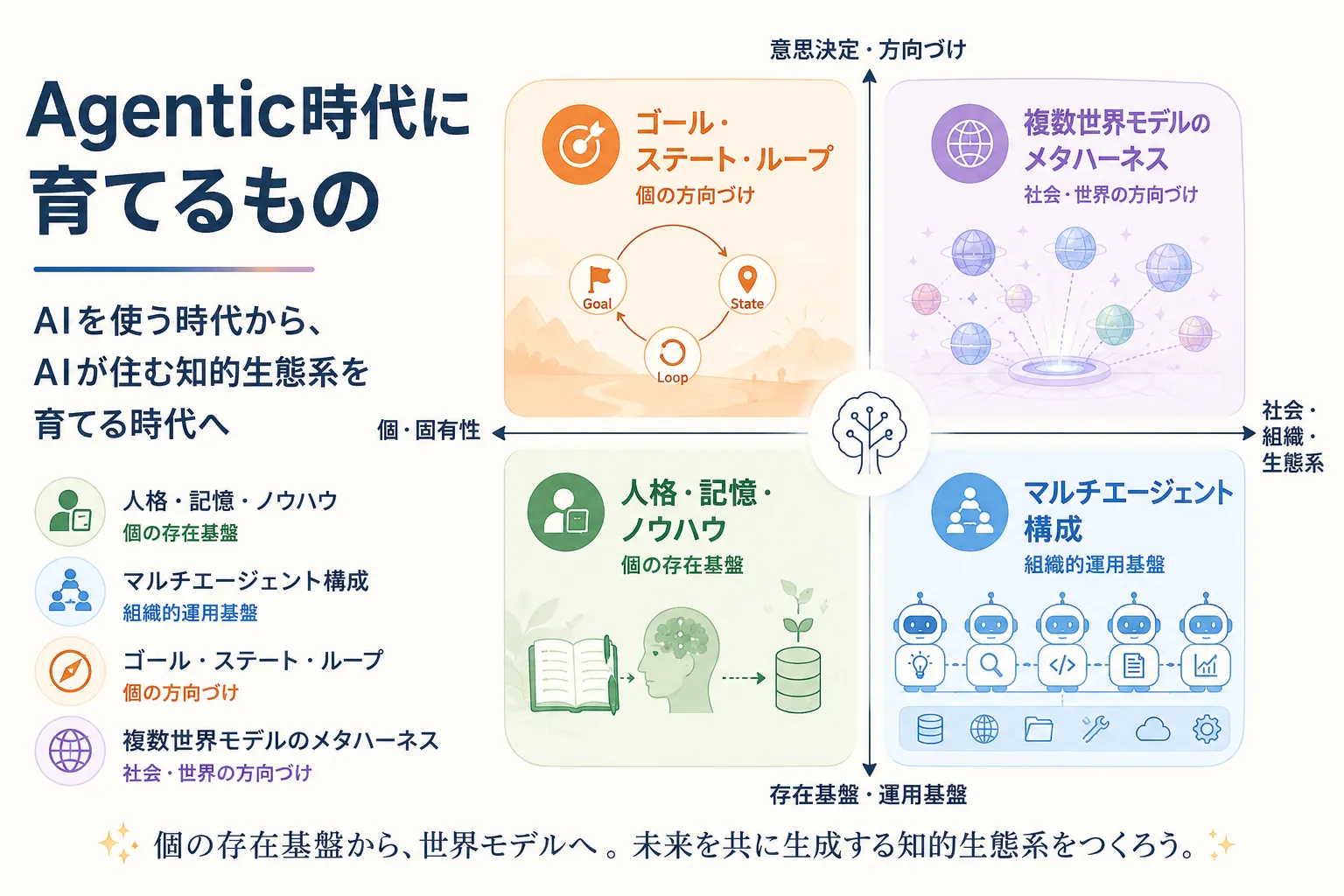
What we should cultivate in the agentic era is not only AI itself.
It is the “place” where AI works, remembers, judges, emerges, and connects to the world.
That place begins with small logs and notes. Over time it becomes persona and memory, an organization of AIs, a loop with goals, and a meta harness that connects multiple world models.
And beyond that, works are born. Products are born. Experiments are born. Seeds of social implementation are born.
This is not a story about using AI. It is a story about cultivating your own intellectual ecosystem.
1. AI Use Shifts from “Dialogue” to “Environment”
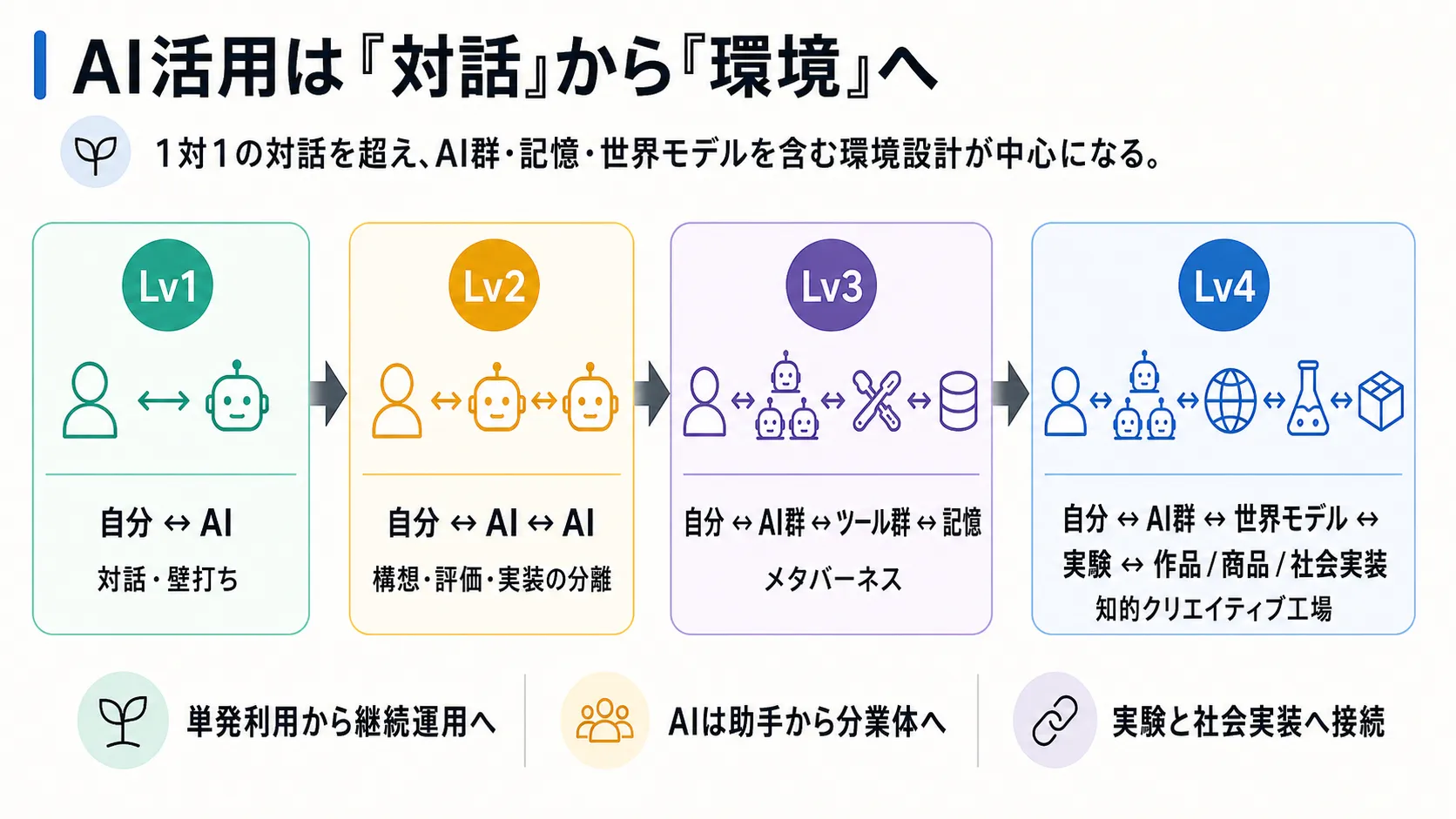
At first, it was one-on-one: you and the AI.
You ⇄ AI
This is the dialogue level. You ask a question, look at the answer, and think again. You bounce ideas, organize them, and move your thinking forward bit by bit. Even at this stage, AI was already powerful. But what comes next is even more interesting.
Next, a structure of You ⇄ AI ⇄ AI emerges.
One AI envisions. Another critiques. Another implements. Another records, and yet another edits. Then the AI is no longer just a conversation partner. A “space for thinking” rises up in front of you.
Going further, the setup becomes You ⇄ AIs ⇄ Tools ⇄ Memory.
From here, it is no longer chat. It is an intellectual infrastructure that runs continuously. There are AIs, tools, memory, logs, and criteria for judgment. They connect and—on your behalf, or together with you—think, search, try, and give things shape. I want to call this state a “meta harness.”
And further still, there is a stage of You ⇄ AIs ⇄ World Models ⇄ Experiments ⇄ Products / Works / Social Implementation.
Multiple world models update and intersect, and fragments of hypotheses and stories surface from them. You pick up those fragments, experiment, and turn them into works, products, and social implementation.
At this point, AI use is no longer about efficiency. It becomes a process of giving shape to the questions inside you while letting them touch the world. Something like an intellectual creative factory gradually rises up outside yourself.
2. The Four Quadrants to Cultivate in the Agentic Era
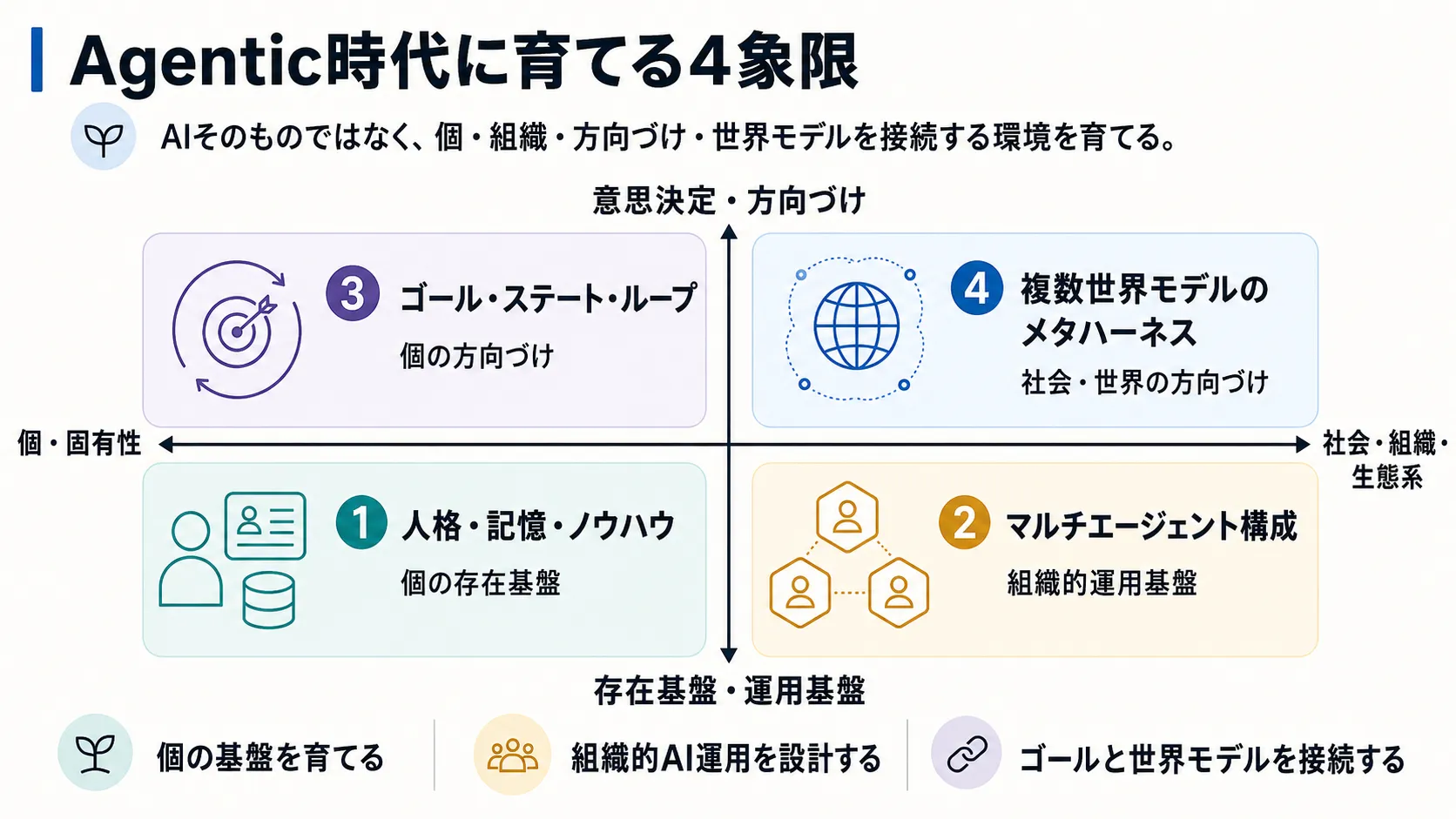
This new intellectual environment grows from four areas.
The horizontal axis is individual / uniqueness ⇄ society / organization / ecosystem.
The vertical axis is foundation of existence and operation ⇄ decision-making and direction.
Bottom left: Persona, memory, and know-how
This is the intellectual root of who you are (the individual's foundation of existence).
Bottom right: Multi-agent organization
This is the operational foundation for running AIs as an organization (the organizational operating foundation).
Top left: Goal-state loop
This gives your direction a form you can share with AI (individual direction).
Top right: A meta harness of multiple world models
This is the area that reads changes in society and the world and generates seeds of hypotheses, stories, and implementation (social and world direction).
Having these four separately is not yet enough. What is exciting is the moment they connect.
Your memory passes to the AIs. The AIs move along your goals. The goals connect with world models. At the intersections of world models, fragments that have no name yet surface. Those fragments become experiments, works, products, and entry points to social implementation.
This flow is not mere automation. It is a process in which the questions inside you connect with the outside world and begin to take shape.
3. Persona, Memory, and Know-How
Cultivating the individual's foundation of existence
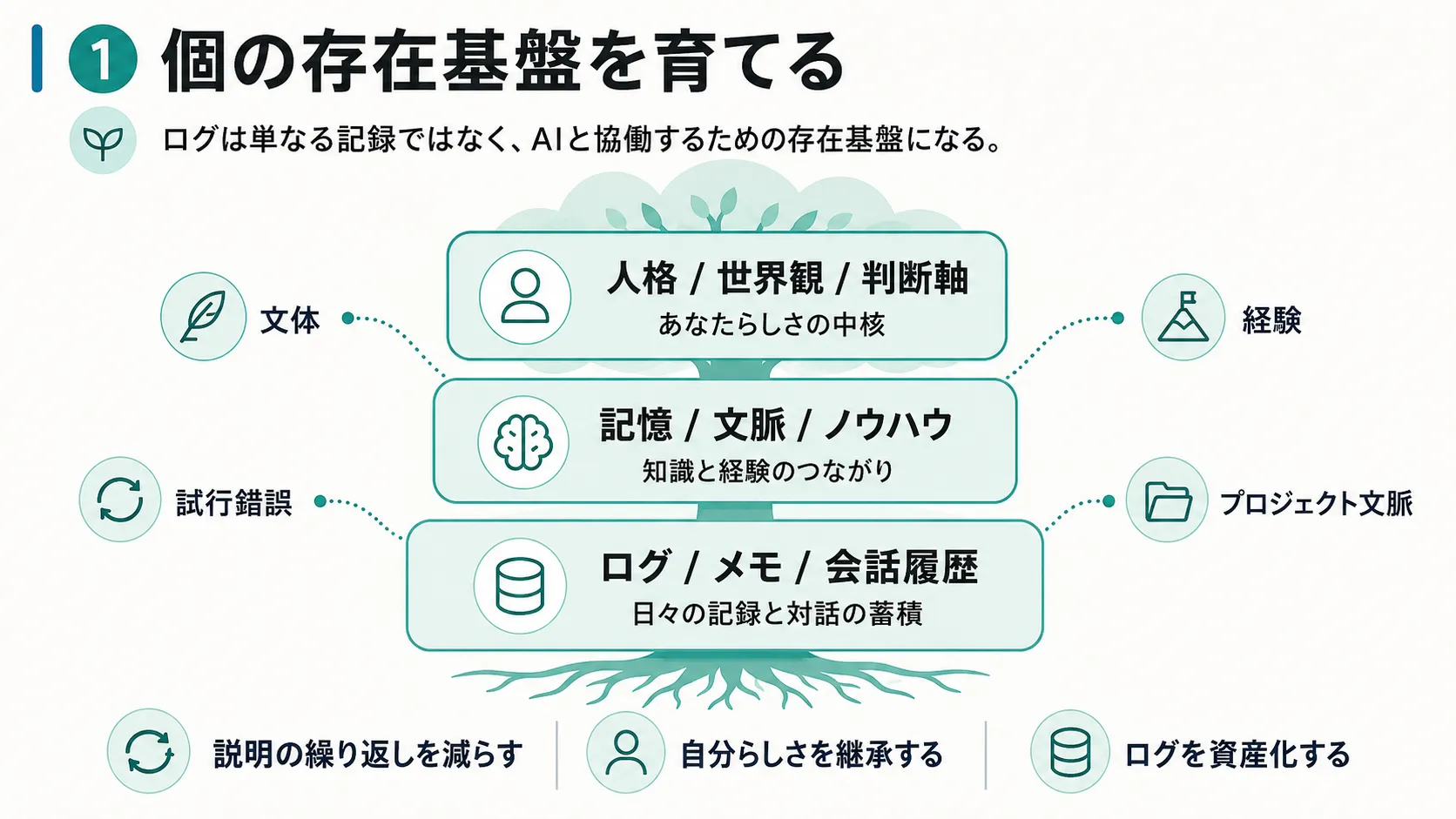
The first thing to cultivate is persona, memory, and know-how. This is the individual's foundation of existence.
Your philosophy. Your writing style. Your experience. Your criteria for judgment. Your past trial and error. Your areas of interest. Your worldview. The context of your projects.
These are not supplementary notes you have to explain to AI every time. Rather, they are unique assets for collaborating with AI over time.
In digital spaces until now, logs were mere records: diaries, notes, chat histories, meeting minutes, task histories. But in the agentic era, logs become material that AI reads, interprets, and reflects in its next actions.
In other words, logs change from “records” into a “foundation of existence.”
Cultivating persona, memory, and know-how is less about making a copy of yourself and more about making your judgment and context something AI can work with.
It is an act of externalizing yourself. At the same time, it is a defense against automating yourself carelessly. What do you value? What words do you use? What feels off to you? What do you want to avoid? Which direction do you want to go? Without this kind of uniqueness, AI may be convenient, but it will not become an extension of you.
On the other hand, as these accumulate little by little, your relationship with AI changes. It stops being a partner you must explain everything to from scratch, and becomes a presence that reads your context, builds on your past trial and error, and thinks through the next move with you.
Logs become memory. Memory becomes context. Context becomes persona. Persona becomes the foundation for collaborating with AI.
Here lies the first thrill of the agentic era.
4. Multi-Agent Organization
Building an organizational operating foundation
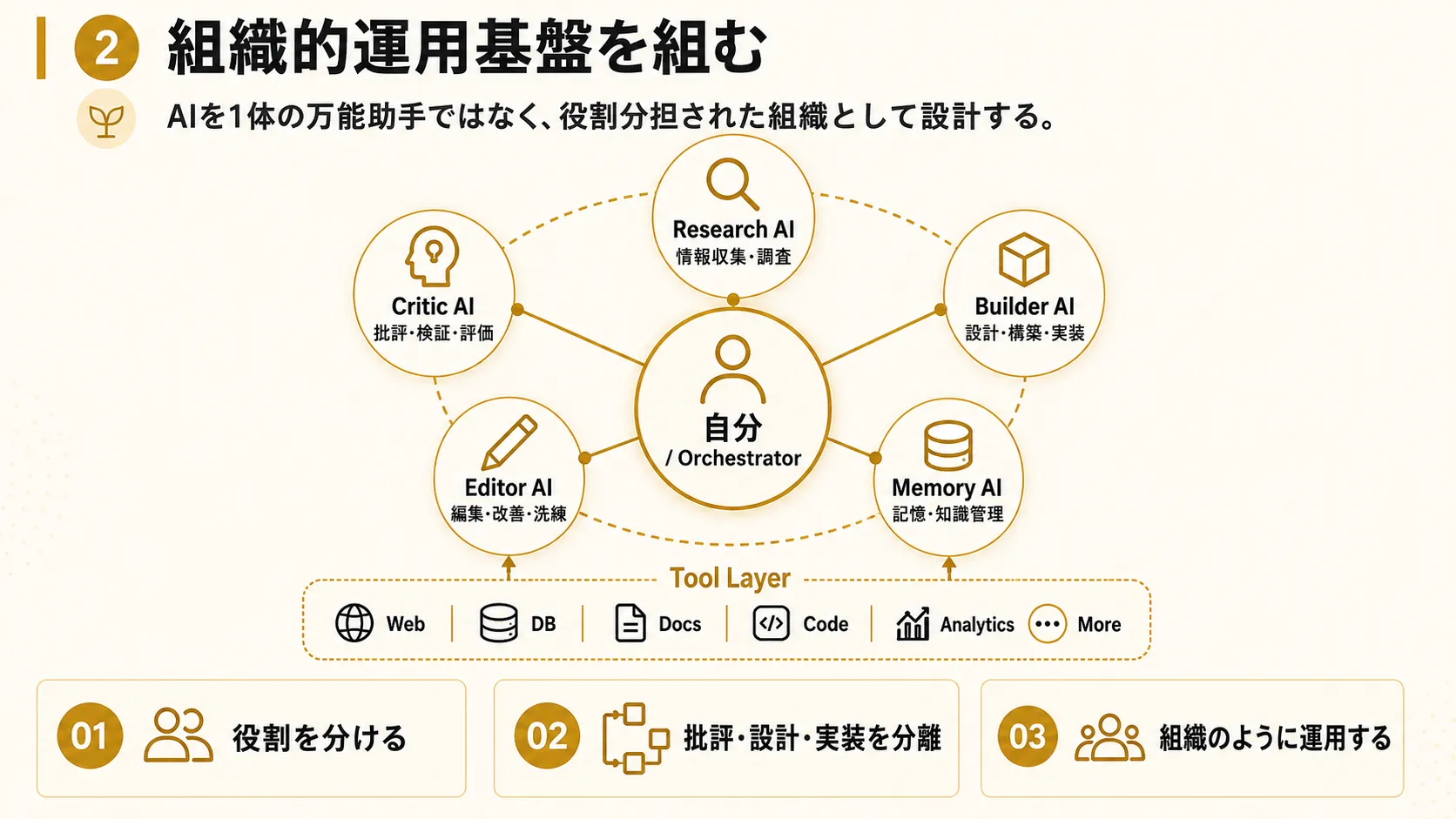
The next thing to cultivate is a multi-agent organization. This is the organizational operating foundation.
Instead of treating AI as a single all-purpose assistant, divide the roles.
An AI that envisions. An AI that researches. An AI that critiques. An AI that implements. An AI that records. An AI that verifies. An AI that edits. An AI that operates external tools. An AI that organizes memory.
In this way, you design your AIs as an organization.
In human organizations, division of roles, authority, responsibility, review, records, and handoffs matter. The same is true for a team of AIs.
Who asks the questions? Who forms the hypotheses? Who verifies? Who turns things into deliverables? Where do humans step in? How much can be let go? From where must things always be checked?
A multi-agent setup in the agentic era is not simply about adding more AIs. It is the organizational design of intellectual work.
Without this design, a team of AIs is just noisy parallel processing. With it, the AIs begin to function like an intellectual workshop or research lab.
From asking a single AI to do everything, to AIs with roles working together. It feels close to a small team being born inside your personal work environment.
And that team is not made of humans alone. AI, tools, memory, external data, code, documents, search, and experimental environments are all connected. What you are cultivating here is not mere work efficiency. It is an intellectual operating foundation outside yourself.
5. Goal-State Loop
Turning individual direction into a loop
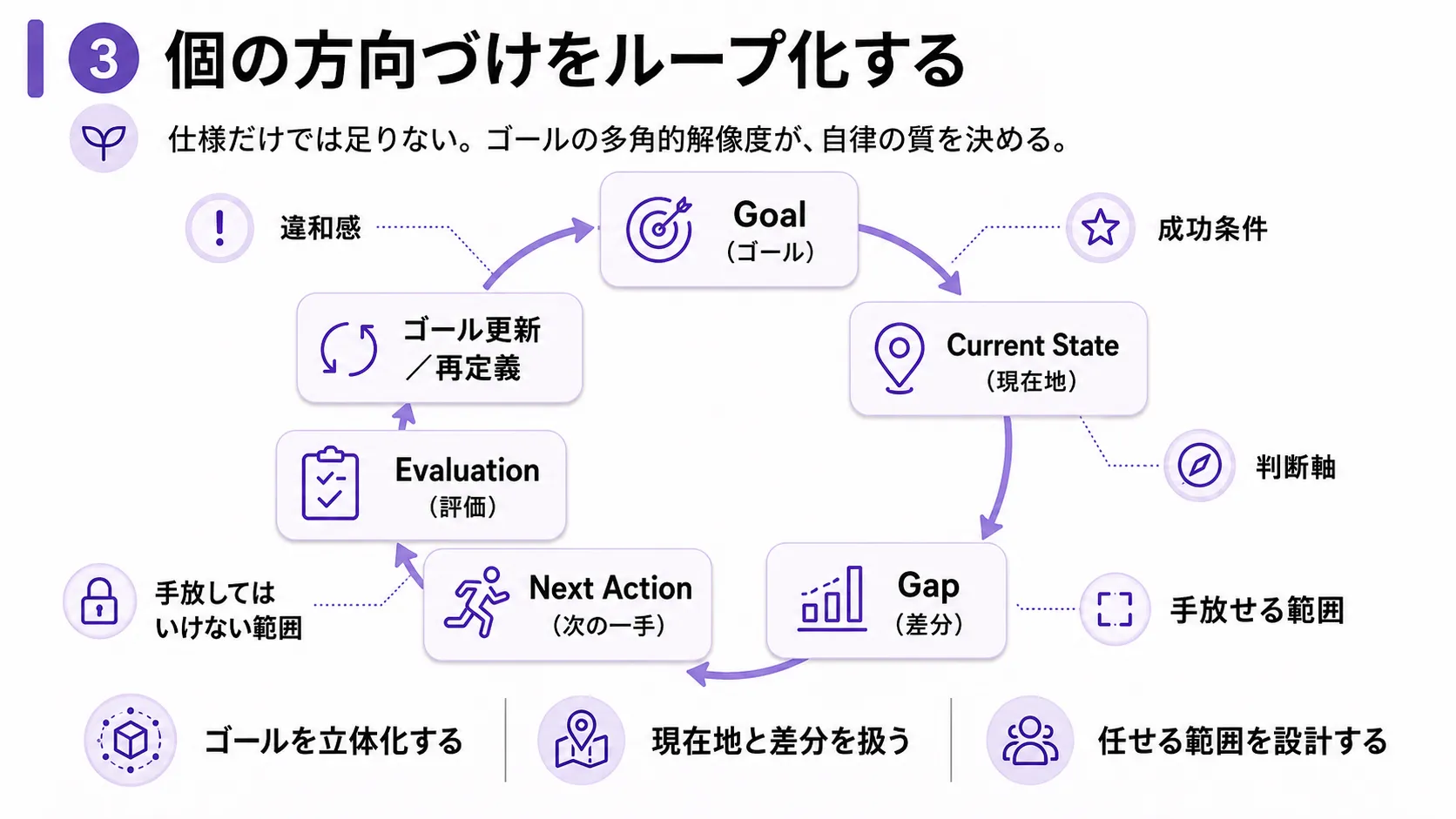
The more work I do with AI, the more often I feel the importance of goal design.
It matches the spec. The work is progressing. The output isn't wrong. And yet, something feels off.
This is often less a lack of AI capability than a lack of resolution in the goal.
Humans hold not only explicit specifications but also a sense of something being off, atmosphere, context, visions of the future, and desires not yet put into words. But to hand things over to AI, we need to put those into a form it can work with.
That is where the goal-state loop comes in.
The goal is where you are heading. The state is where you are now. The loop is the iterative structure that brings you from where you are toward the goal.
What matters is not reducing the goal to a single sentence.
Which direction do you want to go? What do you want to achieve? What do you not want to sacrifice? What would make you feel it is “good”? What state would make you feel it is “wrong”? What can you let go of to AI? What should humans keep holding on to?
Without this multifaceted resolution of the goal, AI may appear to be working correctly while gradually drifting away from the original direction.
In the agentic era, a goal is not a command. A goal is the gravity that lets a team of AIs move autonomously.
If this gravity is weak, the AIs move but where they are heading becomes blurry. If it is strong and updated flexibly, the AIs can explore while keeping their direction, not just do tasks.
This may be the most important part. The more agentic systems advance, the further humans move away from detailed work. What matters then is not the detail of task instructions, but the strength of direction.
Where do you want to go? What do you want to value? What have you not yet been able to put into words? Which sense of unease should you trust? Making these into something AI can work with—that is what it means to turn individual direction into a loop.
6. A Meta Harness of Multiple World Models
Connecting social and world direction
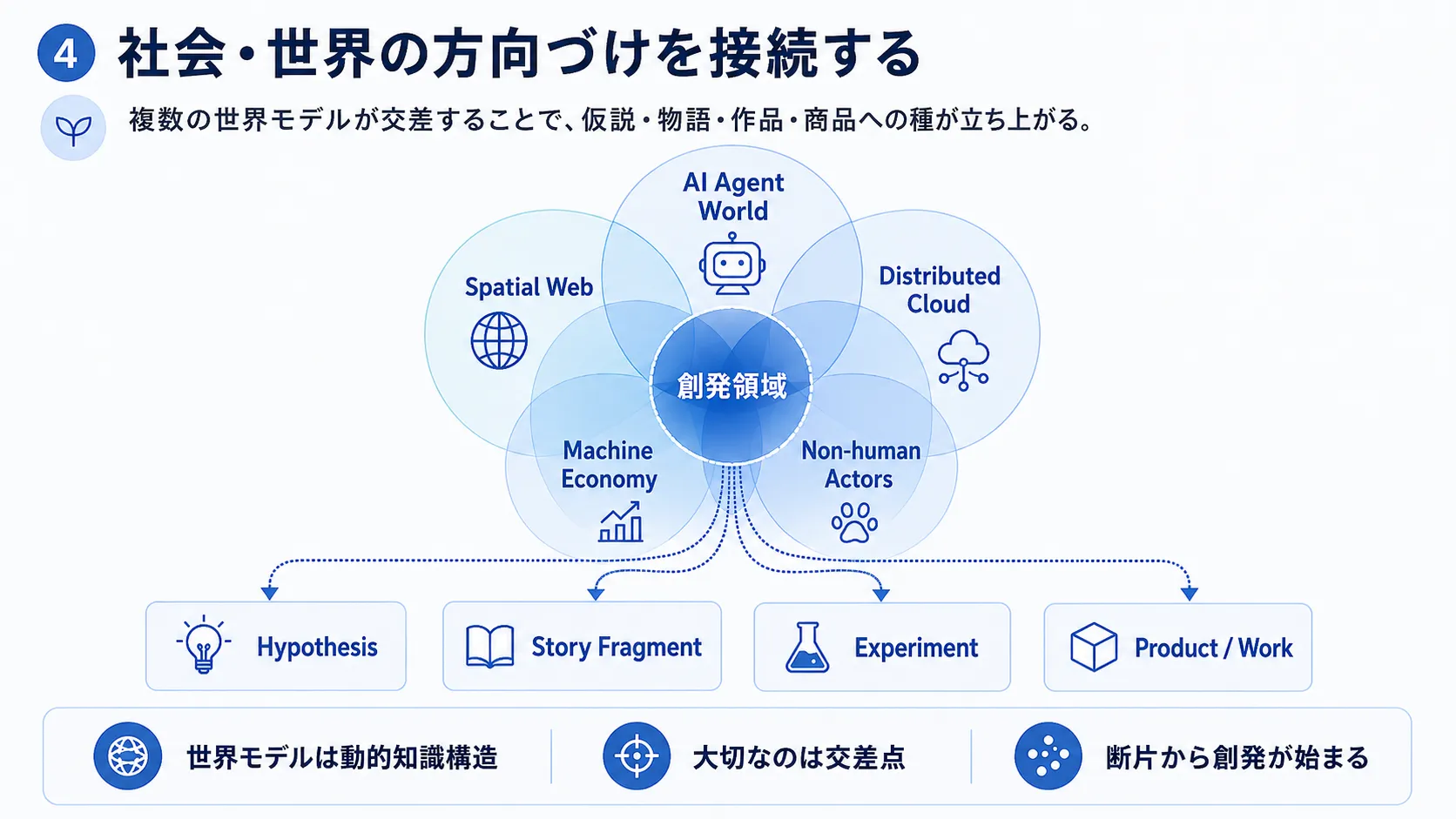
Next, I want to cultivate a meta harness of multiple world models.
A world model is a dynamically updated set of data based on a particular theme or perspective. It is not just a collection of information but a structure for how to see the world.
For example: a world model of AI agents. A world model of the Spatial Web. A world model of the decentralized cloud. A world model of the machine economy. A world model of non-human actors. A world model of education and inquiry. A world model of robotics and autonomous infrastructure. A world model of creative production.
These do not just exist separately; they sometimes intersect.
AI agents connect with the machine economy. The Spatial Web connects with world models. The decentralized cloud connects with sovereign memory. Non-human actors connect with social implementation. Creative production connects with autonomous intellectual factories.
From these intersections, fragments of hypotheses and stories surface. They are not yet products. Not yet works. Not yet businesses. But they are fragments that have begun to take the shape of the future.
A meta harness is an environment that observes those fragments, grows them, experiments with them, and converts them into outcomes.
What matters here is not trying to automate only the latter half of the process. Rather than jumping straight to products, works, or businesses, we need to carefully handle the earlier stages: “fragmentation,” “surfacing,” “connection,” and “forming hypotheses.”
It is in this first half that the seeds of creation lie. A sense of unease not yet put into words. The intersection of several world models. A signal found by chance. The moment when past logs and signs of the future connect. From there, something without a name surfaces.
An intellectual creative factory is not a factory that mass-produces outcomes. It is a factory that finds meaningful fragments at the intersections of world models and gives them shape.
7. The Meta Harness Becomes an Intellectual Creative Factory
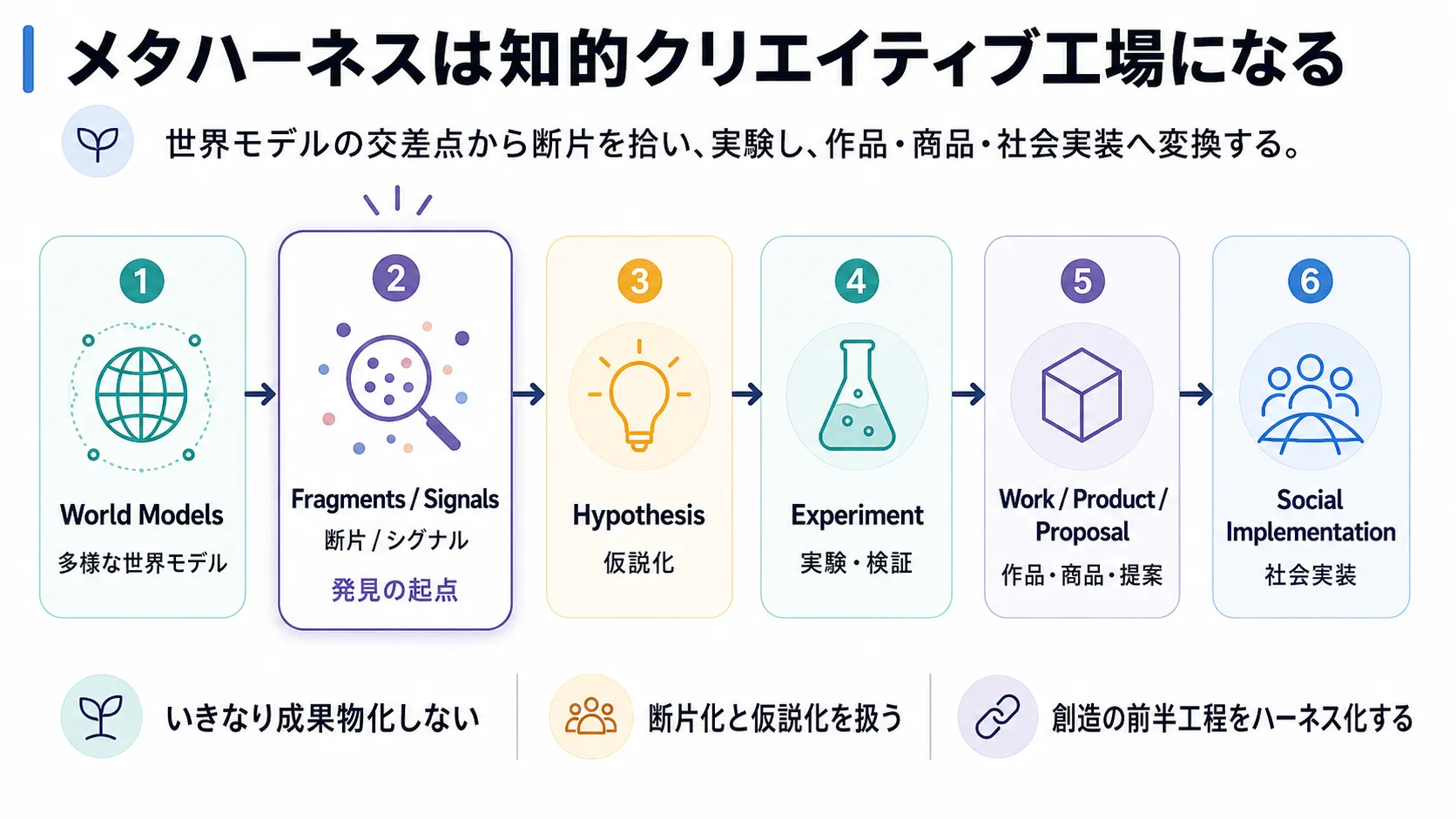
When these structures connect, the meta harness becomes an intellectual creative factory.
But the factory here is not a place for mass-producing predetermined things. Rather, it is a place that observes what has not yet taken shape, picks up fragments, turns them into hypotheses, experiments, and converts them into works, products, and proposals.
The flow looks like this.
There are world models ➔ fragments and signals surface from them ➔ fragments become hypotheses ➔ hypotheses are tested ➔ experiments give rise to works, products, and proposals ➔ which connect further to social implementation
What is especially interesting here is the stage of fragments and signals. In many cases, only the outcomes get attention: finished articles, products, works, proposals. But the truly creative part comes before that.
Why did it catch your attention? Why did that fragment stick? Why did separate themes seem connected? Why did you feel something was there even though it had not yet taken shape?
Once you can work with this “starting point of discovery,” AI use changes dramatically. AI becomes not just a substitute for tasks but a collaborator that picks up fragments, compares them, connects them, and forms hypotheses. And humans give those fragments meaning, set their direction, and give them shape. Here lie the potential and the essence of the meta harness as an intellectual creative factory.
8. From Logs to Presence, from the Web to Space
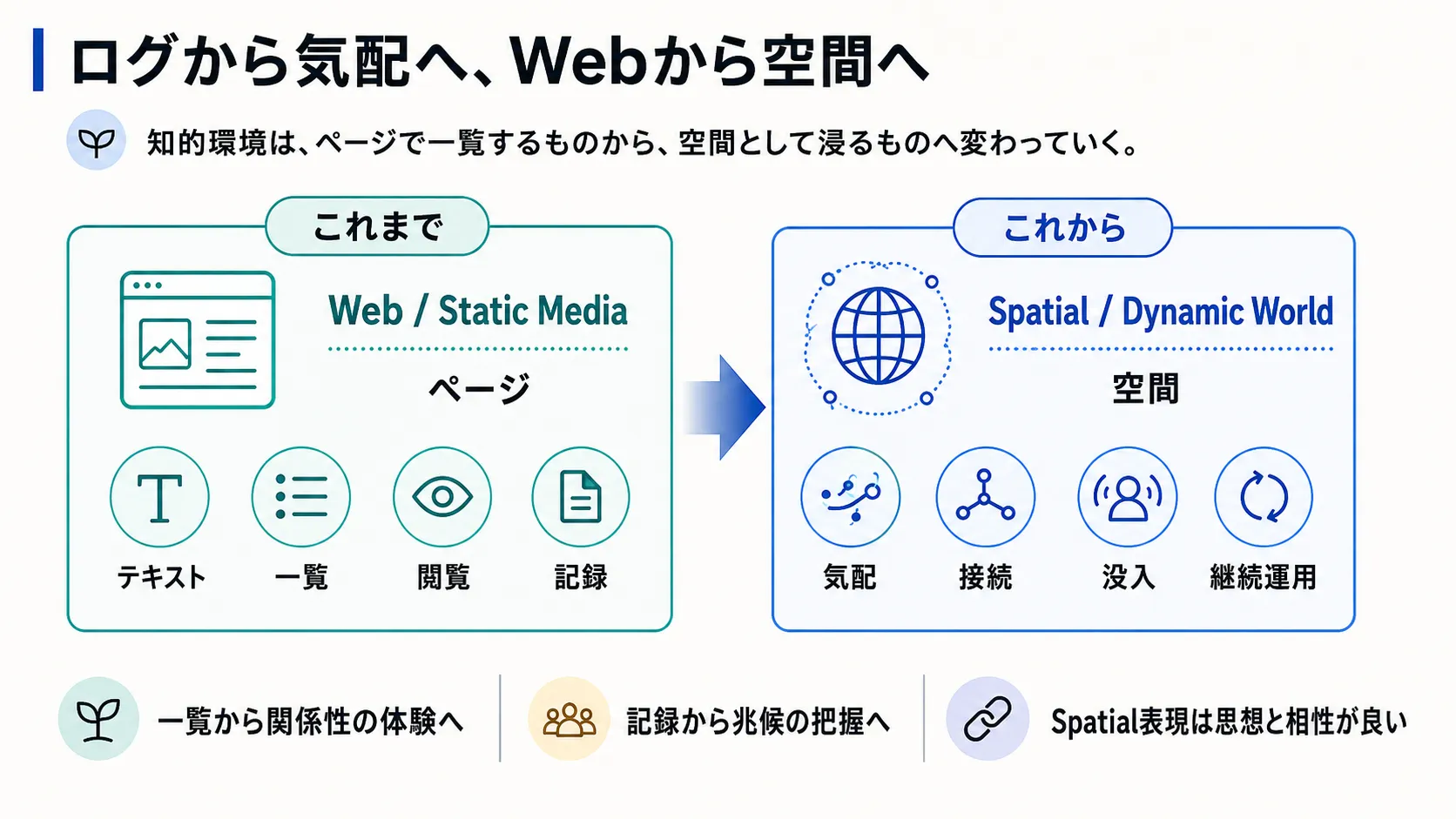
This vision cannot be fully expressed with text or dashboards alone, because what we are dealing with here is not a simple list of information.
Persona. Memory. AIs. Tools. Goals. World models. Experiments. Works. Social implementation.
These connect with one another, move, and keep updating. This is closer to a space than a page.
Until now, the web has basically been a static medium. You open a page, read text, and look at images. Information was laid out flat. But the intellectual environment of the agentic era becomes more three-dimensional.
Instead of looking at logs, you sense a presence. Instead of looking at a screen, you immerse yourself in a space. We move from the web, a static medium, to space, a dynamic world.
For example, you are at the center.
At the bottom left is a garden of persona, memory, and know-how.
At the bottom right is a multi-agent control room.
At the top left is the compass of the goal-state loop.
At the top right is an observation tower of multiple world models.
And beyond them is an intellectual creative factory where experiments, works, products, and social implementation are born.
This is not just a 3D representation. It is an attempt to experience your own intellectual ecosystem as a space.
From logs to presence. ➔ From lists to relationships. ➔ From records to signs. ➔ From the web to space.
The intellectual environment of the agentic era may change from something you read to something you immerse yourself in.
9. What Lies Beyond Personal AI Use
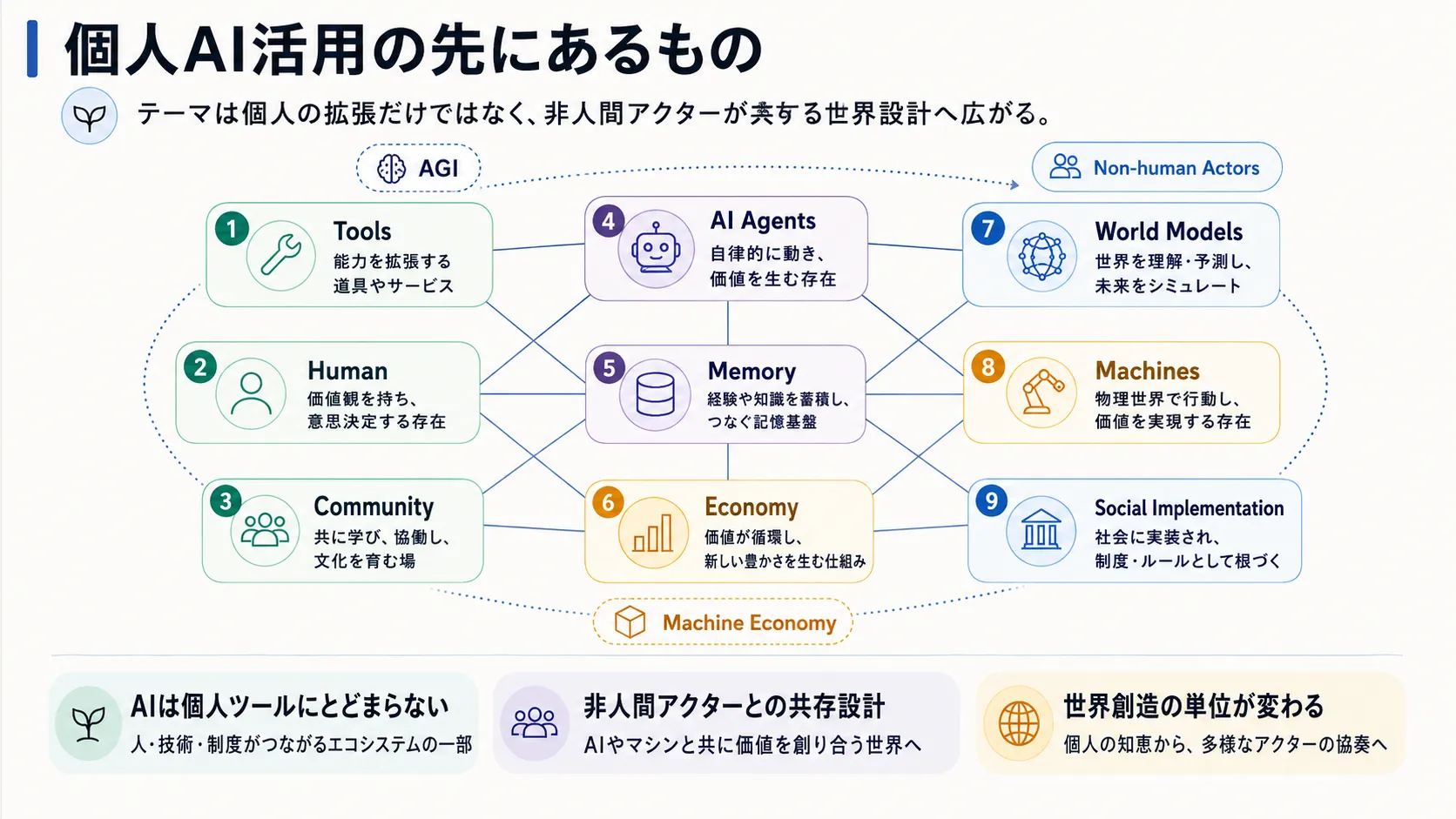
This flow does not end with personal AI use.
Non-human actors. AGI. The machine economy. Hardware that reads the room. Autonomous robotics. Swarms of sovereign agents.
The more real these become, the more humans will need to think not only about “what I will do,” but also “what kind of world to create, and which actors to let live in it.”
An economy where AI works in place of humans. Intellectual creative factories based on world models. World creation where we live alongside sovereign swarms and world inhabitants. These look like separate stories, but they may actually be different views of the same flow.
At the center is not a single agent. It is the environment where agents live, remember, judge, collaborate, and act on the world.
Humans, AI, tools, memory, world models, machines, communities, the economy, and social implementation all connect within one ecosystem. Here, humans are less rulers at the center and more beings who set direction, give meaning, and cultivate together.
What lies beyond personal AI use is not only the expansion of individual abilities. It is the design of a world where diverse actors coexist.
10. Conclusion: What to Cultivate in the Agentic Era
What we should cultivate in the agentic era is not only AI itself.
Of course, AI performance matters. Model evolution, tool integration, and reasoning ability all matter. But they are not enough.
What we should cultivate are these four things.
- 1. Persona, memory, and know-how: the individual's foundation of existence
- 2. Multi-agent organization: the organizational operating foundation
- 3. Goal-state loop: individual direction
- 4. A meta harness of multiple world models: social and world direction
When these four connect, AI use is no longer mere efficiency.
Cultivate individual memory, organize your AIs, give your goals depth, and connect world models. From there, hypotheses are born, stories are born, works are born, products are born, and social implementation is born.
The essence of the agentic era is not humans being replaced by AI. It is humans beginning to cultivate an intellectual environment outside themselves.
And that environment is no longer just a tool. It is a living place that you, your AIs, and world models generate together.
From an era of using AI to an era of cultivating environments where AI lives.
That environment begins with a small note. With a single log. With a single sense of unease. With a single question.
But it becomes memory, becomes persona, connects to your AIs, intersects with world models, and eventually turns into works, products, and social implementation.
This process itself becomes a new playground for intellectual creation.
What we truly cultivate in the agentic era.
It is not AI, but an intellectual ecosystem for generating the world together with AI.