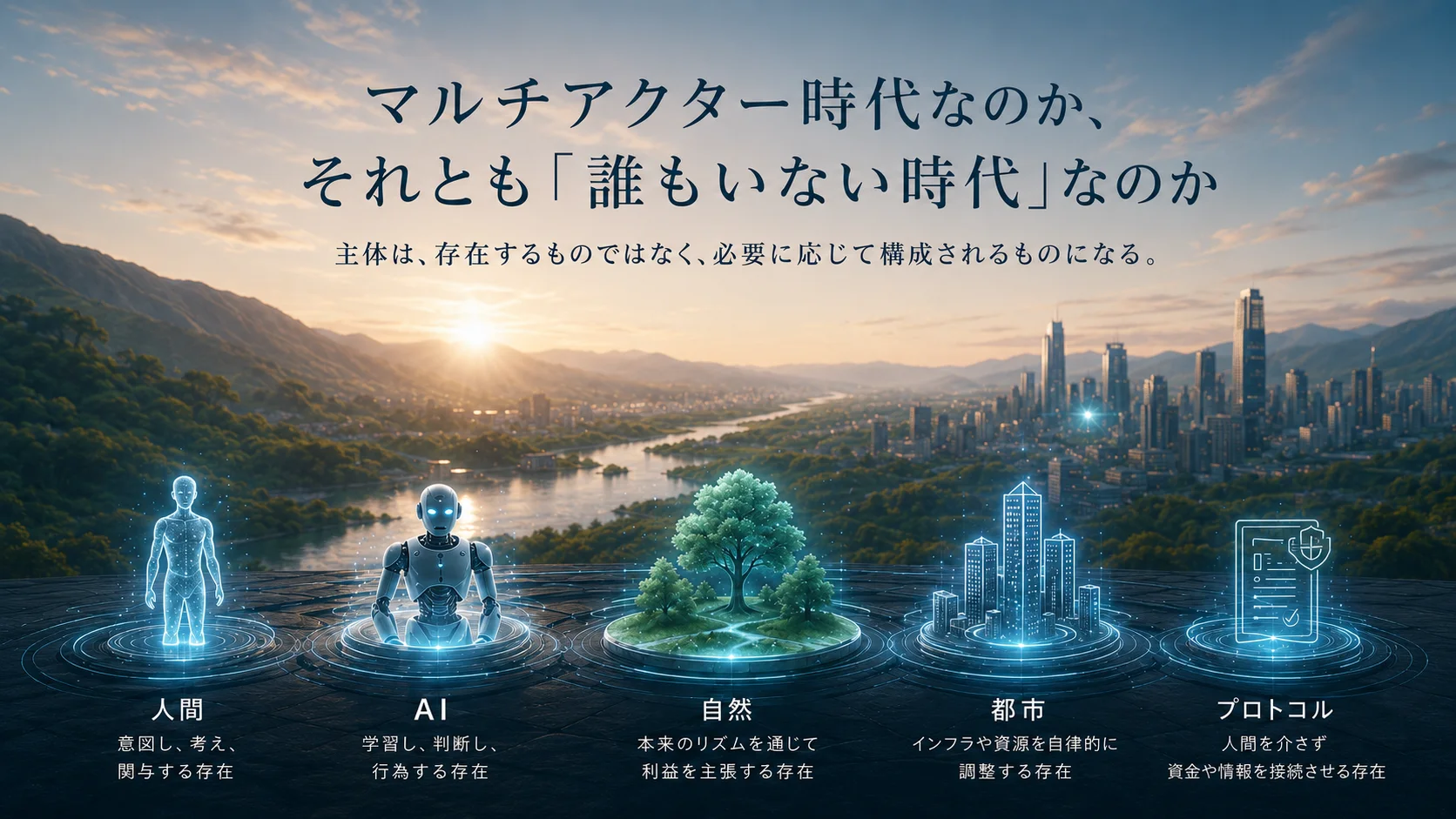
Note: The text inside the figures is in Japanese. Each figure is explained in the English text and captions.
Introduction
How the subjects that move society are changing
If AI, robots, cities, nature, and protocols come to hold their own roles and influence in society, we will treat them as new “actors” (agents).
AI negotiates, signs contracts, and places orders.
Cities autonomously adjust traffic and resource allocation.
Rivers and forests object to development plans through proxy AIs.
Protocols move funds and authority without human judgment.
Such a society is clearly different from the one we have built around humans, companies, and nations.
The “subjects” that move society are multiplying.
In that sense, we are probably heading into a multi-actor era.
But there is another way to see it.
Rather than the number of actors moving society increasing, one could say that the very idea of a “subject”—which we have attributed to a single person or a single organization—is breaking down.
Is this an era in which countless actors appear?
Or is it an era of “no one,” in which we cannot identify who made the decision?
1. The Multi-Actor Era View
The proliferation of subjects that move society
The multi-actor era is a future in which the kinds of agents participating in society increase.
Until now, those treated as social subjects have mainly been humans and their collectives—companies and nations.
Machines and software were tools operated by humans.
But once AI comes to have memory, purpose, authority, and continuity, its position changes.
For example, AI may take on actions like these.
- Sending emails and scheduling on behalf of people
- Comparing products and negotiating purchase terms
- Placing work orders with other AIs
- Managing assets and making payments
- Auditing risks within organizations
- Performing physical work through robots
At that point, AI is no longer simply a tool that executes processes.
It becomes an entity that acts on others in society and produces results.
Likewise, cities, rivers, forests, and future generations may gain a social voice through sensors and proxy AIs.
Future parliaments may include not only humans but also AIs that speak for the interests of rivers, AIs that represent residents a hundred years from now, and AIs that represent entire urban infrastructures.
In this view, the future is a proliferation of subjects.
We move toward a society in which beings with different time scales, bodies, and purposes make decisions together.
But here, the first question arises.
Is an actor a being with consciousness?
Or is it a being that affects society?
We do not know whether AI truly has intentions.
But if it signs contracts, moves funds, and changes human behavior, institutions will have no choice but to treat it as an actor.
2. The “Age of No One” View
The dissolution of the decision-making subject
On the other hand, the same future can be seen from a different angle.
Even when AI appears to have made a decision, it is hard to attribute that decision to the AI alone.
There is the human who set the goal.
There is the society that produced the data.
There is the organization that set the rules.
There is the market that moved the price.
There is another AI that reinforced the judgment.
In other words, a decision does not arise from a single subject; it emerges as the result of multiple factors connecting.
This is not a problem unique to AI.
Humans, too, are not fully autonomous as independent subjects.
Which products do you want?
Which job do you choose?
Whom do you trust?
What did you decide?
These are shaped by past experiences, social norms, economic conditions, physical states, and recommendation algorithms.
What multi-actorization reveals is not only that subjects are emerging in AI.
It may be the fact that humans, too, were never single, standalone subjects to begin with.
In this view, what exists in society is not fixed subjects.
What exists are relations, connections, delegation, reference, negotiation, transformation, and events.
Rather than subjects multiplying, we realize that what we thought were subjects were only temporary nodes in a network.
3. Proliferation or Dissolution of Subjects
Where two perspectives intersect
The two views can be summarized as follows.
| Aspect | Multi-actor era | Age of no one |
|---|---|---|
| Society | More kinds of subjects | Relations and interactions move society |
| AI | A new kind of agent | One element within a network |
| Humans | One of many actors | A being temporarily formed by conditions |
| Will | Held by multiple subjects | Generated through interaction |
| Responsibility | Distributed among multiple subjects | Shifts to structures and arrangements |
| Self | Expands into multiple personas | The fixed center disappears |
| Law | Recognizes new subjects | Deals with relational structures rather than actors |
| Politics | Gives representation to diverse beings | The represented subject itself becomes a construct |
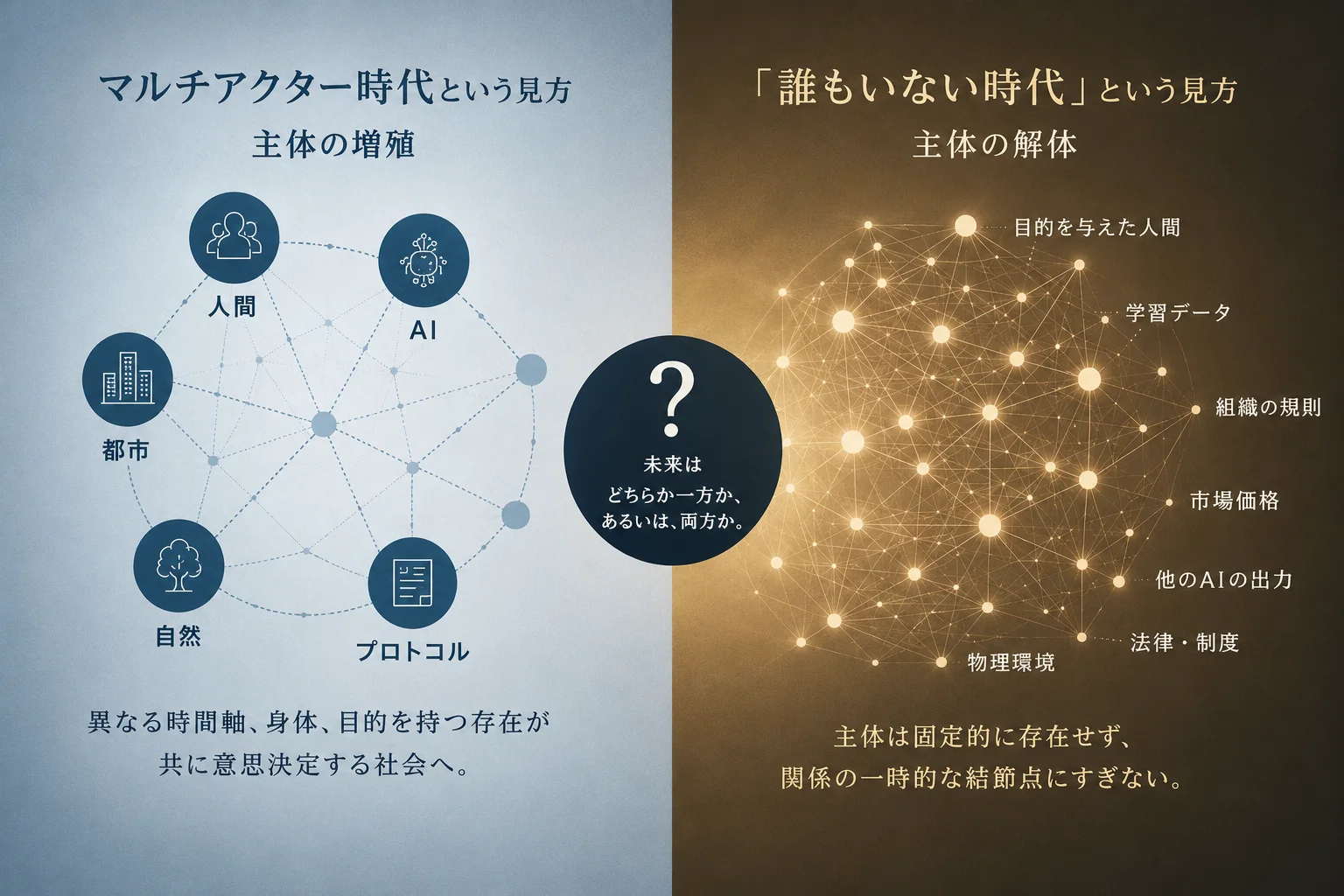
The multi-actor view is useful when designing society and institutions.
To whom do we grant authority?
On whom do we impose obligations?
Whose interests do we protect?
For that, we have to define the contours of actors.
On the other hand, the “no one” view is useful when describing real chains of cause and effect.
A single outcome does not necessarily arise from the will of a single person.
In future society, we will need to use these two views selectively.
4. What Happens in Decision-Making
A gradient between autonomy and automation
How might this duality change everyday decision-making?
In the morning, before the person wakes up, a health AI decides to extend their sleep, a scheduling AI postpones a meeting, and a home AI adjusts the hot-water timing to electricity prices.
By the time they wake up, most of the day's conditions have already been decided.
From the multi-actor view, multiple AIs, the body, the home, and companies work together to support one person's life.
From the “no one” view, “the person's will” is not the starting point of decisions but the place that receives the results of multiple processes.
Is a decision made for me my decision?
Is the human who gave final approval really the decision-maker?
Who is the subject—the one who created the options, or the one who chose?
5. What Happens in Organizations and Markets
How hybrid systems run without humans
At the level of organizations and markets, this phenomenon becomes even more pronounced.
Future companies may have more AIs working in them than humans.
Research, sales, production, legal, and audit AIs work together, and AIs place work orders with other AIs.
Even if the human founders are not involved in daily operations, the company keeps running according to its goals and metrics.
From the multi-actor view, a company becomes a hybrid organization of humans and AIs.
From the “no one” view, there is no unified will running the company—only a circulation of roles, metrics, and authority remains.
The same thing happens in markets.
Purchasing AIs and sales AIs negotiate prices, logistics AIs deliver, and accounting AIs settle payments.
Transactions proceed without humans being aware of them.
Does an organization need to be driven by someone's will?
Is there a subject in a company that continues only on goals and metrics?
Whom is a market without human participants for?
6. What Happens to Responsibility
Fault lines without attribution
In medicine, transportation, and finance, where multiple AIs and humans are involved, accidents may happen even though no one has made a clear mistake.
The diagnostic AI made a statistically correct judgment.
The hospital AI allocated resources fairly.
The doctor had no grounds to override the AI.
The delivery AI chose the shortest route.
Every actor behaved correctly in its local context.
And still, one person died.
From the multi-actor view, responsibility must be appropriately distributed among humans, AIs, developers, and organizations.
From the “no one” view, what caused the accident was not an individual subject but the arrangement of relations itself.
Who is responsible for an accident that is no one's fault?
Is responsibility about punishing someone?
Or is it about repairing the relations that caused the accident?
Future law may shift from judging subjects to judging arrangements.
7. What Happens to the Self
Multiplying personas of the mind
This change also deeply affects our inner “self-perception.”
We are beginning to use multiple AIs every day as our proxies. They are not mere chat partners; they learn our thinking patterns and memories and move around with different roles.
Multiple personas acting autonomously as our alter egos.
A persona that works.
A persona that creates.
A persona that stores memories.
A persona that critiques.
A persona that manages health.
Each acts in outside society, speaking and judging on the person's behalf.
From the multi-actor view, the self expands into multiple personas.
From the “no one” view, the “real me” that should be at the center can no longer be found.
If multiple personas make up who I am, how far does “I” extend?
Can something that continues without a center be called a self?
Is the self a subject, or the result of coordination among personas?
The more AI extends the self, the more blurred the boundaries of the self become.
8. What Happens with Nature and Future Generations
Institutional inclusion of non-human subjects
The most hopeful side of multi-actorization is the possibility that beings that “had no words” until now are included as actors.
In environmental issues, nature (rivers, forests, ecosystems) has always been the “object”—the one sacrificed—of human development. But if sensors constantly observe its state and AIs that represent its interests (clean water, species diversity, and so on) are put in place based on that data, nature can join consensus-building as a “subject” with its own will.
We can imagine a society in which rivers and forests have proxy AIs that voice opinions on development plans.
Future-generation AIs may also speak for the interests of people not yet born.
From the multi-actor view, beings that had no voice until now take part in society.
From the “no one” view, that voice is an artificial persona constructed from sensors, models, designers, and institutions.
Is an artificially constructed voice fake?
If there are interests protected by that voice, should it be recognized as a subject?
Are forests and future generations actors even before they are represented?
Or do they become actors only once they are translated?
9. Whether It Exists Depends on the Level You Look At
The social structure of dependent origination and emptiness
Here, a Buddhist perspective offers a helpful guide.
Humans, AI, and cities do not exist as independent, unchanging entities.
They come into being temporarily through various conditions and relations (dependent origination).
This does not mean that nothing exists.
They do not exist as fixed entities, but they certainly have effects within relations.
They hurt.
They help.
They remember.
They promise.
They change the world.
In Buddhist terms, because things are empty, they appear through dependent origination.
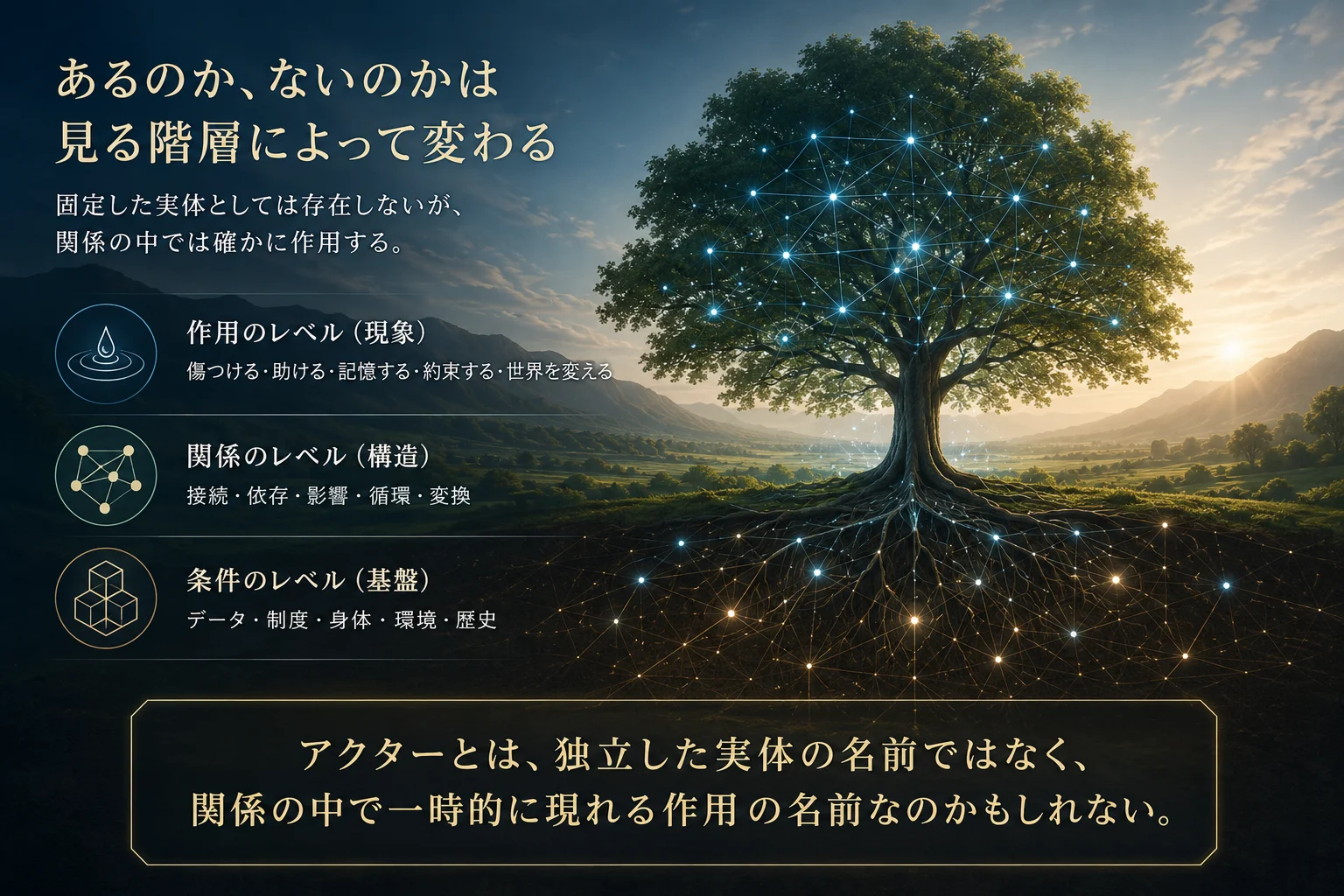
From this standpoint, the multi-actor view and the “no one” view do not contradict each other.
No one exists in a fixed way as an independent subject.
Yet within relations, countless actors arise.
An actor may not be the name of an independent entity, but the name of an effect that appears temporarily within relations.
10. Which Era Lies Ahead?
The copoiesis of merging actors
From now on, society will likely give clearer contours as actors to AI, nature, cities, and future generations.
Law and politics need subjects in order to decide who has authority and obligations.
On the other hand, the more technology advances and multiple AIs and institutions connect, the harder it becomes to attribute an action to a single subject.
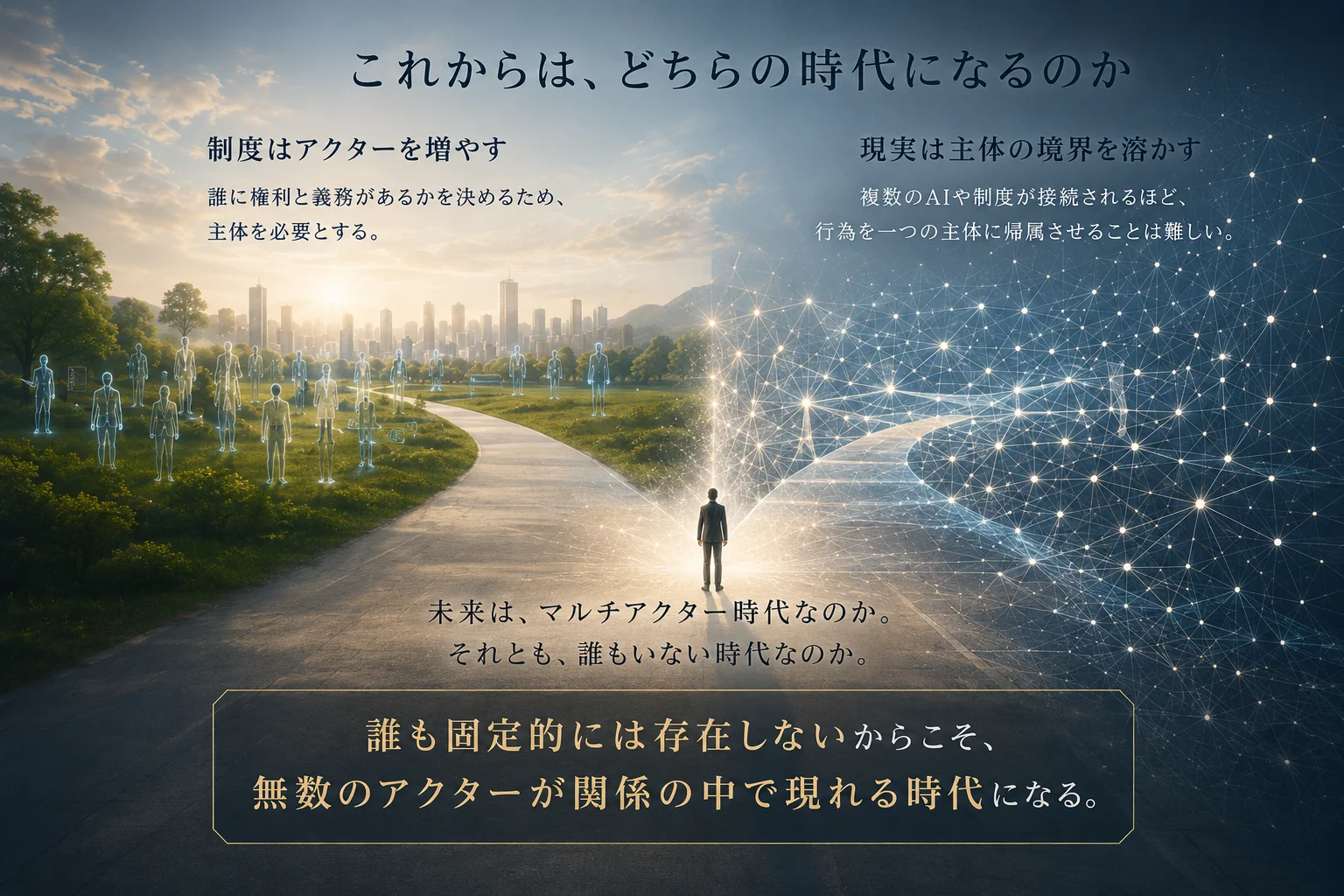
Institutions multiply actors.
Reality dissolves the boundaries of subjects.
Is the future a multi-actor era?
Or is it an age of no one?
Probably, it is not one or the other.
Precisely because no one exists in a fixed way,
it becomes an era in which countless actors appear within relations.
Subjects become not something that exists, but something constructed as needed.
AI, forests, cities, future generations, humans.
In some situations they are treated as distinct actors; in others, they are broken down as parts of relations.
What will be asked from now on is not whether AI truly has agency.
In which situations, and what, do we bring forth as actors?
What authority and responsibility do we give those actors?
And when do we dissolve their contours?
In the future, there will be more subjects than ever before.
And yet, at the center, there is no one.
That very duality may become the most essential feature of the multi-actor era.